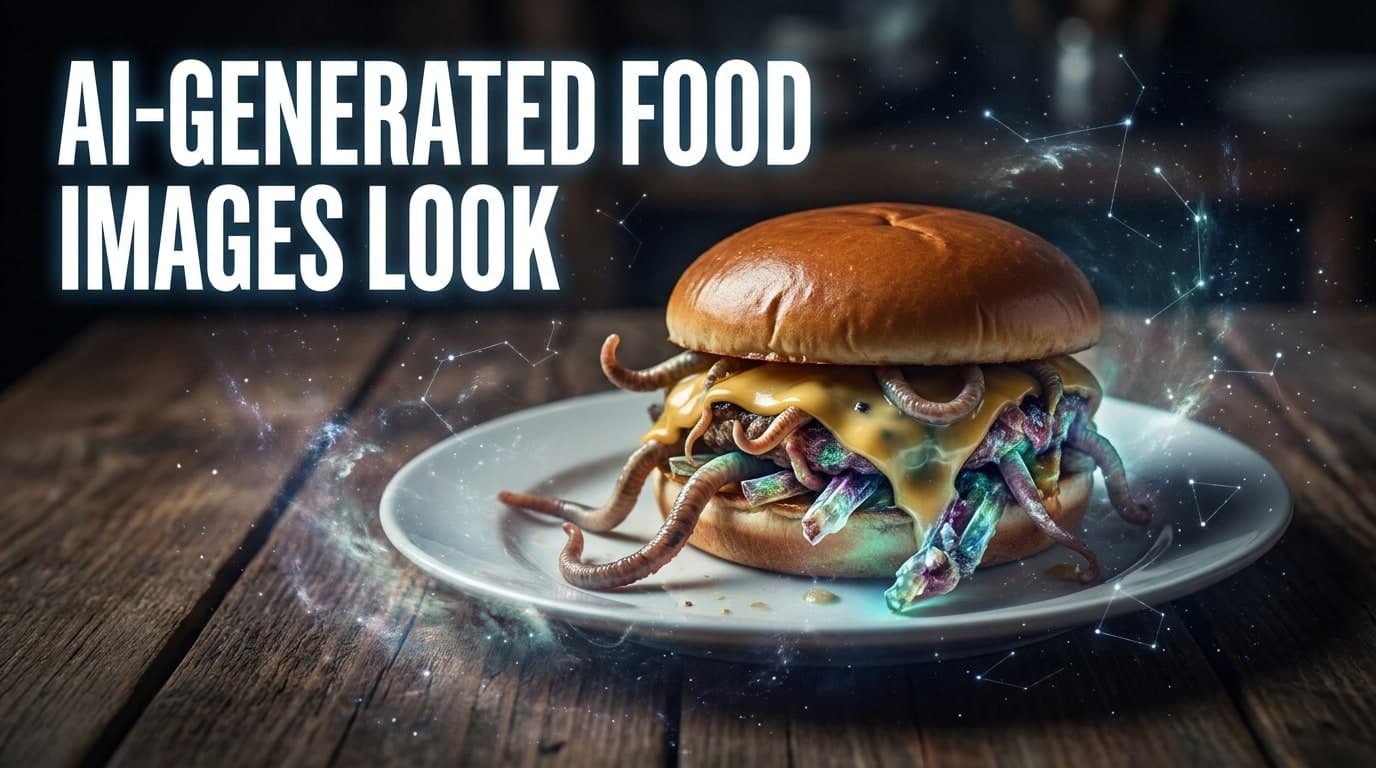
Restaurants and food brands are increasingly using AI-generated images to advertise meals, and many look grotesque, wormy, or diseased. The trend matters because it reveals hard technical limits in the image-generation tools now spreading across advertising, menus, and everyday visual content.
What actually happened
The Verge reported on 4 September 2026 that AI-generated food images from restaurants and brands often look unsettling, citing examples such as "donut shrimp" and wormlike noodles, The Verge said. Chris Russell, a professor of AI, government, and policy at the University of Oxford, said diffusion models build coarse structures first, then add fine texture, so early errors get compounded. Giovanbattista Califano, a behavioral scientist at the University of Naples Federico II, said "diffusion models are notoriously weak at generating thin, continuous, terminating structures," causing noodle-like artifacts to spread into unrelated areas. Roland Meyer, a professor at the University of Zurich, said AI models reproduce "looks without proper knowledge about the world." Michael Cook, a senior lecturer at King's College London, noted models are increasingly trained on other AI-generated material, a practice linked to what researchers call model collapse.
How we got here
AI image generators, especially diffusion models, became widely used for marketing content in recent years, letting brands skip professional food photography. These models learn statistical patterns from large training sets scraped from the internet, not real-world physics or culinary logic, according to The Verge. Because striking or unusual food photos spread more widely online, ordinary images of food are underrepresented in training data, said Simon Colton, a professor at Queen Mary University of London. Newer models are also increasingly trained on earlier AI outputs, a feedback loop researchers say can cause visual degradation over time.
Why this matters for you
For brands, this is a trust problem. Grotesque food images can damage credibility, especially when real photos were an easy alternative. For AI developers, the failures point to concrete technical gaps, thin structures and repeating textures, that need fixing before generated visuals can reliably replace photography. For anyone building overlays on smart glasses or AR displays, the same diffusion weaknesses matter beyond food. Any system rendering objects in real time inherits these structural blind spots. Users should treat AI-generated imagery, food or otherwise, with added scrutiny until models better represent physical structure.
The bigger question
If AI image generators still struggle to represent something as familiar as food, what does that suggest about their reliability for more complex visual tasks? As AR and smart glasses increasingly depend on AI to generate or interpret images in real time, the same structural weaknesses seen in food photos could appear anywhere a machine renders an object it does not truly understand.
What to watch
No fixes or model updates were announced alongside this report, published 4 September 2026. Researchers cited in the piece flag model collapse and thin-structure rendering as open technical problems for the field. Bonuz will track how image-generation tools handle fine detail and structure, since the same limitations could affect AI-rendered visuals in future AR and smart-glasses interfaces.