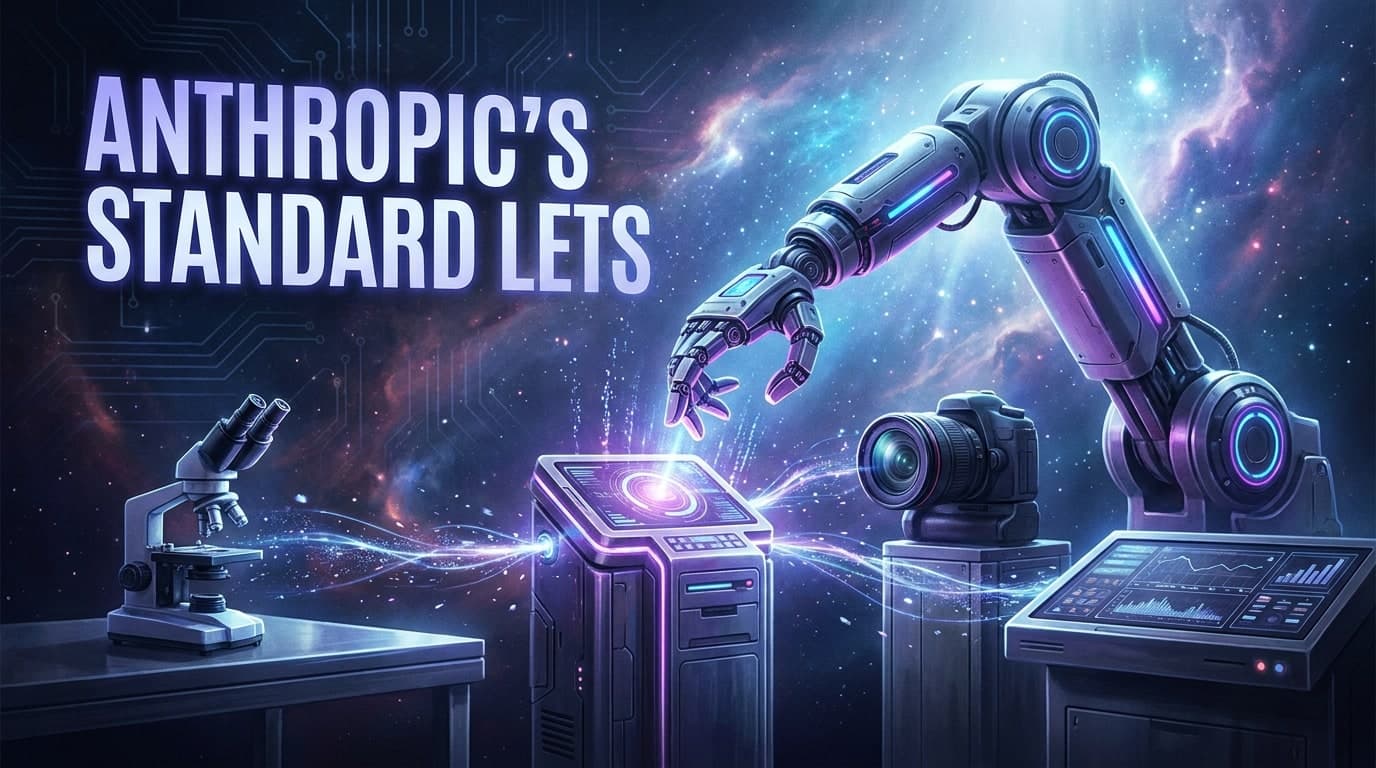
Anthropic unveiled the Model Hardware Standard, a new system letting AI agents like Claude directly control lab equipment, robotic arms, and cameras. This matters because it pushes AI out of screens and into physical devices, a step toward machines that can run experiments and operate machinery on their own.
What actually happened
Anthropic released the Model Hardware Standard (MHS) as a research preview, detailed in Anthropic's new hardware standard lets AI agents control the physical world. MHS gives AI agents a common interface to control lab equipment, robotic arms, and cameras without custom software for each device. Anthropic technical staffer Alek Kemeny said the idea came from watching neuroscientist Arco Bast wire together lasers, microscopes, and cameras at the HHMI Janelia Research Campus in Ashburn, Virginia. "This idea could be used to have AI run any science experiment in the world," Kemeny said. Anthropic says MHS can cut integration time from weeks or months down to hours or minutes. Early partners include Amazon Web Services, Hugging Face, Raspberry Pi, Automata, and Universal Robots.
How we got here
Agentic AI has mostly stayed inside computers, writing code, browsing, and generating images. Anthropic built MHS on top of its existing Model Context Protocol, first released to let AI models call external tools and data sources. MHS extends that logic to physical hardware, adding standardized tags for weight, range, safety limits, and adjustable parameters. Anthropic demonstrated Claude reasoning through picking up an aluminum can with a robotic arm it had never been trained on, and calibrating a laser and microscope by checking camera feedback. The company says a year of testing with scientific partners already sped up experiment setup.
Why this matters for you
For researchers, MHS could shrink weeks of lab setup into minutes, letting scientists test more hypotheses faster. For builders, an open, agent-agnostic standard means device makers will not need bespoke AI integrations for every model. For manufacturers like Universal Robots and Automata, early alignment with MHS could shape which hardware AI agents support first. For everyday users, this points toward a future where AI agents run physical devices beyond a screen, including robots, sensors, and eventually wearables. Safety evaluations built during this preview period will likely shape rules for how much autonomy AI gets over physical machinery.
The bigger question
Anthropic says safety evaluations are being built during this preview period. But as AI agents move from typing text to physically operating lasers, robotic arms, and lab equipment, one question remains open: how much autonomy should AI hold over machines that can cause real physical harm, and who decides where that limit sits, the AI company, the hardware maker, or the person standing nearby?
What to watch
Anthropic has not given a public timeline for when MHS moves beyond research preview. The company plans to make it open source and agent-agnostic after testing with its first partners, AWS, Hugging Face, Raspberry Pi, Automata, and Universal Robots. Expect safety evaluation results and expanded partner lists as the next signals. Bonuz will track MHS as a marker for how AI moves from software into wearable and hardware devices.