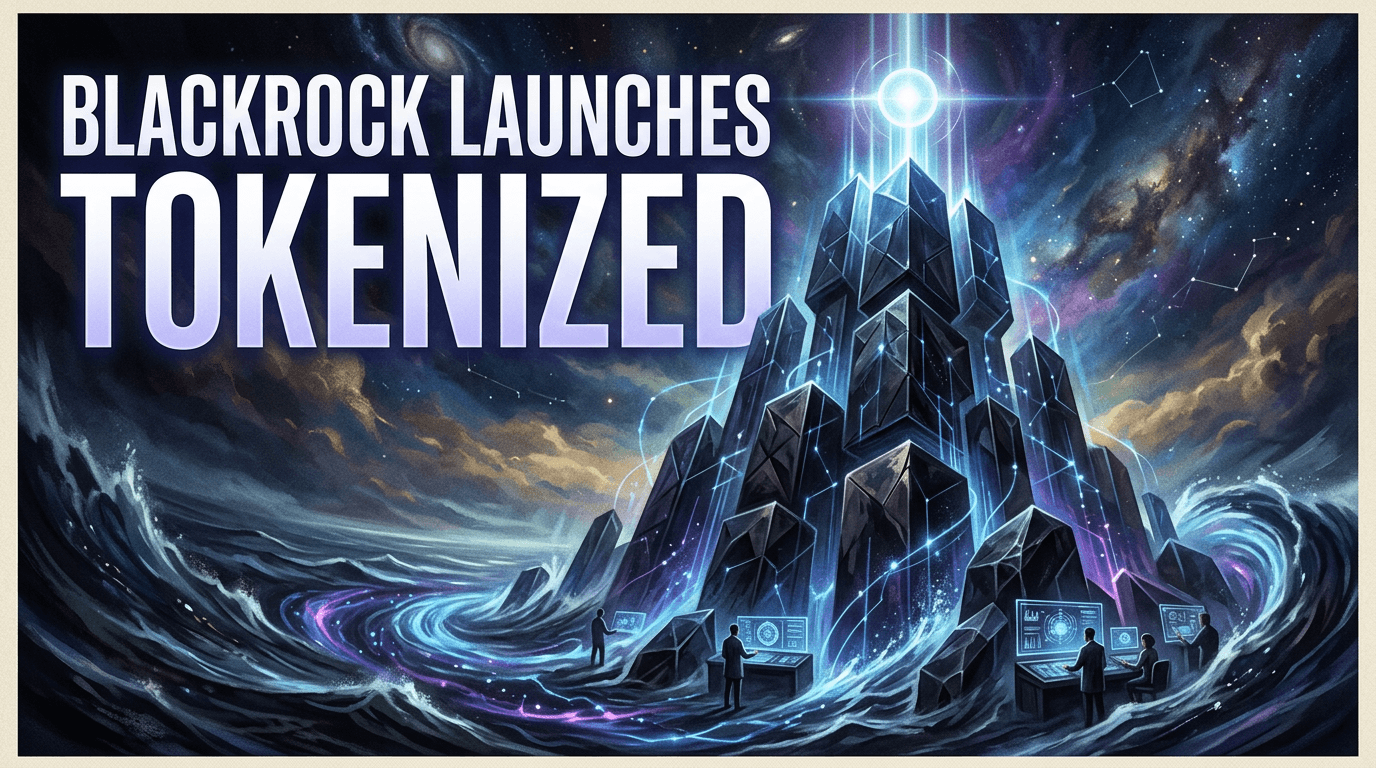
BlackRock launched two new tokenized money market products, BSTBL and BRSRV, built to serve as reserve assets for U.S. stablecoin issuers under the GENIUS Act. The move signals that traditional finance's largest asset manager is racing to control the infrastructure behind dollar-backed digital money, a market already worth $300 billion (USD).
What actually happened
BlackRock unveiled the BlackRock Select Treasury Based Liquidity Fund (BSTBL), a tokenized share class on Ethereum, and the BlackRock Daily Reinvestment Stablecoin Reserve Vehicle (BRSRV), which offers daily dividend reinvestment across multiple blockchains, according to a press release cited by CoinDesk. BlackRock filed for both products with the U.S. Securities and Exchange Commission in May 2026. Securitize will serve as BRSRV's transfer agent and tokenization provider. Both funds intend to qualify as eligible reserve assets under the GENIUS Act. BlackRock Chief Financial Officer Martin Small said during the Q2 2026 earnings call, "We already manage $60 billion (USD) of reserves for Circle, representing about a quarter of the $300 billion (USD) stablecoin market." Jon Steel, Global Head of Product and Platform for BlackRock's Cash Management business, said the funds give clients "additional choice in how they access and use money market fund investment solutions."
How we got here
BlackRock entered tokenized finance in 2024 with BUIDL, its first tokenized money market fund, built with Securitize. BUIDL has since grown to roughly $2.5 billion (USD) in assets and is now used across crypto markets as collateral for borrowing and leveraged trading. U.S. money market funds overall hold more than $8.4 trillion (USD) in assets, and BlackRock's Cash Management Group oversees nearly $1.073 trillion (USD) for corporations, banks, insurers, and public funds. CEO Larry Fink has repeatedly called tokenization a way to modernize markets. The tokenized real-world asset sector has grown more than 200 percent in a year, passing $30 billion (USD), according to rwa.xyz.
Why this matters for you
For stablecoin issuers, these funds offer a regulated, yield-bearing place to park reserves while staying compliant with the GENIUS Act. For crypto traders, tokenized cash like BUIDL already doubles as collateral, and BSTBL or BRSRV could extend that utility across more blockchains. For BlackRock, this cements its bid to become the default reserve manager for stablecoin issuers, competing directly with banks and other custodians. For everyday users of stablecoins, it means the dollars backing their tokens increasingly sit inside tokenized institutional funds rather than plain bank deposits, changing who holds the risk and the yield.
The bigger question
If tokenized money market funds become the default reserve asset for stablecoins, who ultimately controls the dollars underpinning digital money: the stablecoin issuers, the asset managers running the funds, or the blockchains recording the transactions? As more of the $300 billion (USD) stablecoin market flows into products like BSTBL and BRSRV, this question will shape how much influence traditional finance holds over crypto's core plumbing.
What to watch
BlackRock filed for BSTBL and BRSRV with the SEC in May 2026 and confirmed the launch on 3 August 2026. Watch for data on how many stablecoin issuers choose these funds as reserves, and whether adoption tracks Citi's projection of a $5.5 trillion (USD) tokenized securities market by 2030. Future earnings calls will likely update reserve figures tied to Circle and other partners.