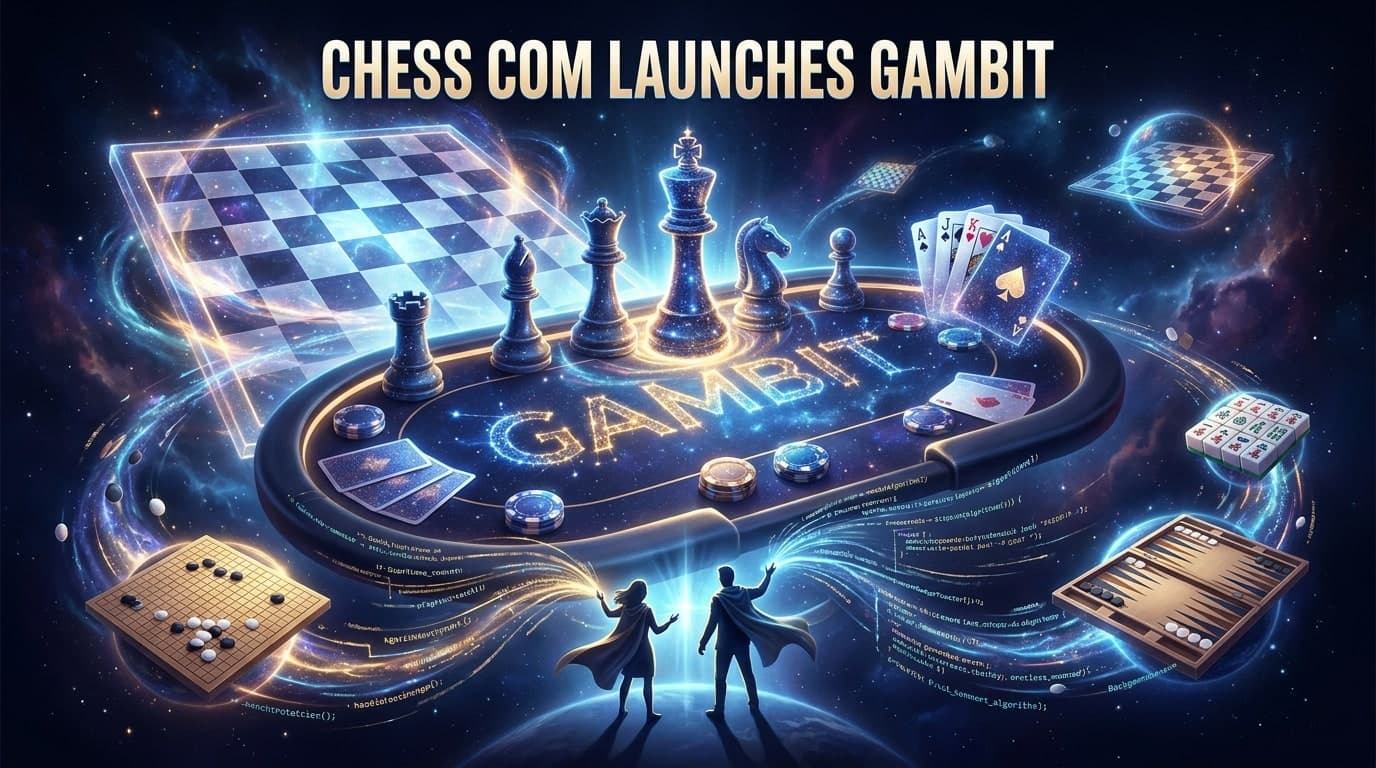
Chess.com launched Gambit, a free poker site with no real-money gambling, and plans to expand into go, backgammon, and mahjong. A two-person team built it in under a year using AI coding tools. That shows how small teams can now ship complex software fast.
What actually happened
Chess.com launched Gambit in beta in May 2026, its first companion site after nearly 20 years focused only on chess. Albert Cheng, Chess.com's chief growth officer, told The Verge the company avoided real-money gambling by design. "Real money is the problem we built Gambit to get away from, the whole industry makes money when beginners lose," Cheng said. Gambit uses an Elo-style rating system, mirrored on Chess.com's subscription model, where free play is standard and paid tiers unlock unlimited game reviews and lessons. A two-person team built Gambit from prototype to launch within a year, aided by AI mainly for coding tasks. On 31 August 2026 at 12PM ET, Gambit livestreams its first Gambit Cup on Twitch and YouTube, featuring cofounder Danny Rensch and creator Alexandra Botez.
How we got here
Chess.com built its business over almost 20 years as a single-purpose chess platform. It grew mainly through free play, plus a subscription tier for unlimited reviews and lessons. Cheng said AI let a small team read Chess.com's existing codebase quickly. The team applied its design patterns to a new platform. Previously, that work would have needed a much bigger team, or disrupted core chess development. Early Gambit prototypes used AI-generated art assets. Cheng said the live version today has close to zero AI-created assets. That shift, from AI as a first draft tool to an infrastructure accelerator, mirrors a broader 2026 pattern. Small teams increasingly ship products once reserved for larger studios.
Why this matters for you
For casual poker players, Gambit offers a way to learn the game and track skill through ratings, without financial risk. For builders, Cheng's account is a data point. A two-person team shipped a full companion platform in under a year. They used AI for coding, not for design or brand work. That could lower the cost of launching niche gaming platforms generally, including within crypto and Web3 gaming communities exploring skill-based, non-gambling formats. For Chess.com users, expansion into go, backgammon, and mahjong matters. The same account, rating logic, and subscription model may soon apply across several classic games, not just chess and poker.
The bigger question
If AI lets small teams build entire platforms in months, what happens to the assumption that new games need large studios and years of work? Chess.com's approach also raises a question about monetization. Can skill-based ratings, rather than real-money stakes, sustain competitive gaming at scale? Or does removing financial risk eventually reduce the intensity that keeps players engaged long term?
What to watch
Gambit livestreams its first Gambit Cup on 31 August 2026 at 12PM ET on Twitch and YouTube, with Danny Rensch and Alexandra Botez. Chess.com has not set launch dates for its go, backgammon, or mahjong sites, though Cheng says development is moving quickly. Readers tracking how AI reshapes small-team software development, a theme bonuz follows closely alongside hardware and AR trends, should watch for Chess.com's next platform announcement.