
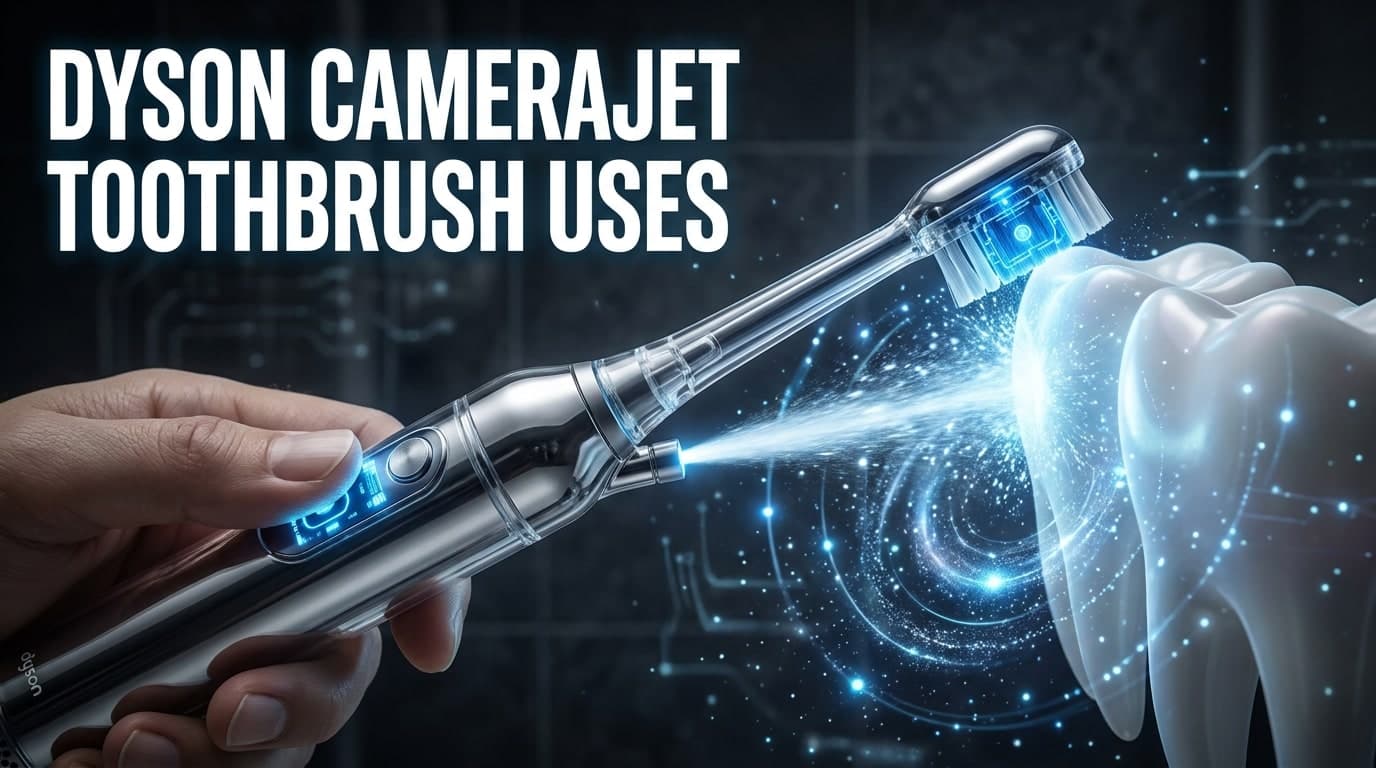
Dyson launched the CameraJet, a $499 (USD) electric toothbrush with a built-in camera that detects gaps between teeth and blasts them with mouthwash to floss automatically. It matters because it shows how fast miniature cameras and on-device AI are moving into everyday personal hardware, not just phones and headsets.
What actually happened
Dyson released the CameraJet on 1 September 2026, priced at $499, in ceramic blue and ceramic pink, The Verge reported. The brush head carries a camera with 100,000-pixel resolution and a strobing light. Dyson's AI analyzes 28 images per second in a process it calls Gap Optical Targeting. Within 100 milliseconds of detecting a gap, the device fires a cone-shaped blast of mouthwash to clean it, according to the report. Images are processed on-device and not stored or sent to the cloud, per The Verge. The brush head oscillates nearly 1,000 times per second. Each replaceable head carries an RFID tag that tracks usage and signals a replacement every 3 months. The dock refills the toothbrush's 12.5ml mouthwash reservoir in 3 seconds.
How we got here
Dyson built its reputation on vacuums and hair care, using motor and airflow engineering to enter crowded categories with a premium twist. The CameraJet extends that playbook into oral care, a market already filled with smart toothbrushes from established brands that track brushing patterns through phone apps. Those devices mostly rely on motion sensors and app coaching after the fact. Dyson's toothbrush instead puts a live camera and edge AI directly on the brush head, letting it see inside the mouth and act in real time. Water flossers have existed for decades, but pairing one with automated, camera-based gap detection is new, per The Verge.
Why this matters for you
For consumers, the CameraJet trades manual flossing for a $499 upfront cost, plus ongoing spend on replacement heads and Dyson's planned low-foaming toothpaste and mouthwash. For builders, it signals that on-device cameras paired with real-time AI, without cloud dependency, are now viable in small, battery-powered consumer hardware. That is the same engineering challenge facing AR and smart glasses makers, who need compact cameras and local processing that work instantly without draining a battery. Dyson's approach to power, optics, and privacy-by-design offers a working example outside the headset category.
The bigger question
If a toothbrush can carry a camera and real-time AI without sending anything to the cloud, what other everyday object gets one next? How much personal, close-up data will people accept from small always-on cameras, even when makers promise nothing leaves the device. This is a genuinely open question for any hardware category built on cameras worn close to the body, including smart glasses.
What to watch
The CameraJet is available now in ceramic blue and ceramic pink. Pricing for replacement brush heads has not been announced. Dyson has not confirmed a release date for its companion low-foaming toothpaste and mouthwash, built to keep the camera's view clear. Whether Dyson brings similar camera-and-AI sensing to other personal care devices remains to be seen.