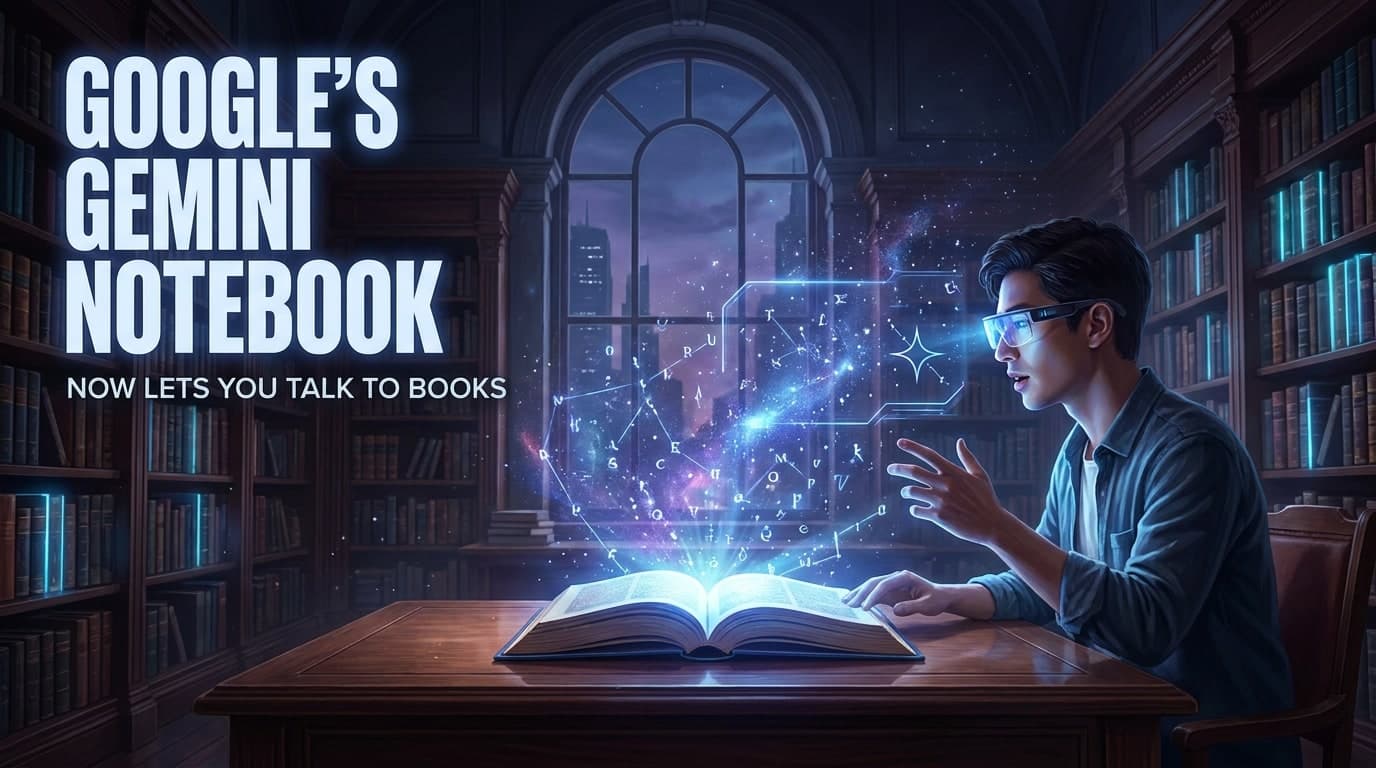
Google's Gemini Notebook now lets users chat directly with books they own. The new Expert Intelligence feature turns purchased titles into interactive AI sources, a small but telling sign of how voice and AI interfaces, the kind AR glasses will rely on, are replacing traditional search and reading.
What actually happened
Google announced the Expert Intelligence feature on 27 August 2026, according to The Verge. The tool pulls content from books bought on Google Play Books directly into Gemini Notebook, letting users ask questions, generate infographics, build plans, or create AI podcasts from the text. More than 100,000 titles from publishers including Penguin Random House, Johns Hopkins University Press, Macmillan Publishers, and O'Reilly Media support the feature at launch. Google worked with 15 authors, including Michael Pollan, Kim Scott, Steven Pinker, and Jennifer Wallace, to build customized 'Featured Notebooks'. Google Labs editorial director Steven Johnson said the goal is 'building a collection of people whose work you really value' into a 'dream team of advisers' available anywhere. Google also built protections so unpurchased books cannot be read in full by other users who view a shared notebook.
How we got here
Google renamed its NotebookLM app to Gemini Notebook, adding project organization tools before this update. Gemini Notebook already fed information into AI Mode in Search and the Gemini app. Expert Intelligence pushes that further, turning purchased books into interactive AI sources rather than static text. Google frames this as new revenue for authors and publishers, not just a reading feature. The company plans to expand it to scholarly articles, magazine articles, and newspapers, following the same publisher partnership model already used for books.
Why this matters for you
For users, this means AI tools that answer with an author's actual reasoning, not a generic summary, which matters for anyone using AI for research, coaching, or study. For builders, Expert Intelligence shows how licensed content can become a product layer, not just training data, a model that could extend to any interface, including AR glasses that surface expert knowledge hands-free. For publishers and authors, Google is testing a direct revenue path tied to purchases rather than ad views. For crypto and Web3 users watching the AR thesis, this is a preview: voice-first, source-grounded AI is the layer that future smart glasses will need to feel useful rather than gimmicky.
The bigger question
If AI can answer using an author's own reasoning, does anyone still need to read the whole book? Google calls this a 'dream team of advisers' available anywhere, but that convenience raises a bigger question about depth versus speed. Publishers are betting readers will pay for curated access rather than full ownership of ideas. Whether that trade holds up once this expert-AI layer moves from an app on a phone to a voice in your ear on a pair of glasses is still unanswered.
What to watch
Google has not set a date for bringing Expert Intelligence to AI Mode in Search or the wider Gemini app, both of which already pull from Gemini Notebook. No timeline was given for adding scholarly articles, magazines, or newspapers as sources. Bonuz will track how licensed, source-grounded AI features like this migrate toward voice and wearable interfaces, the layer smart glasses will ultimately depend on for everyday usefulness.