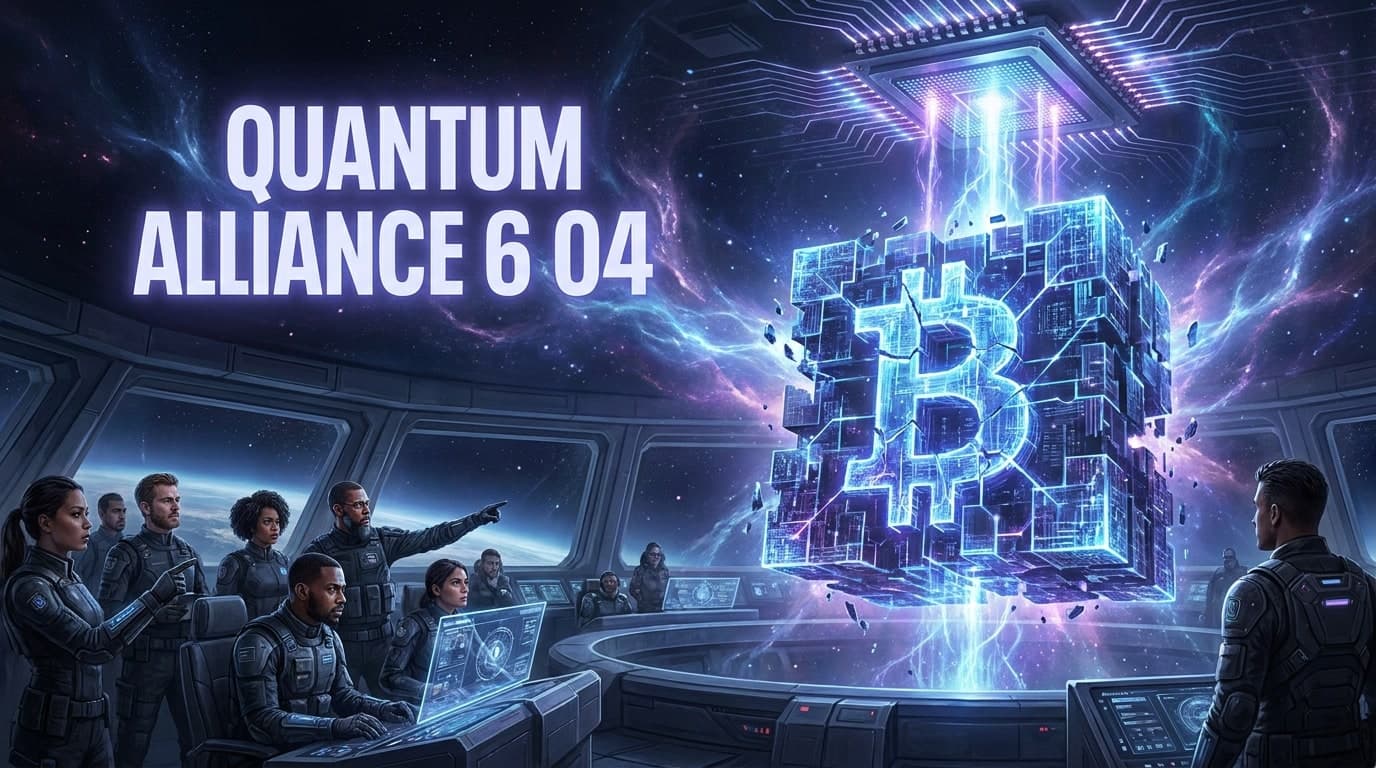
Nine blockchain companies, including Quantus and Hacken, formed the Quantum Alliance on Thursday to standardize quantum-resistance testing. The group warns 6.04 million BTC, about 30% of circulating supply, already sit exposed to a future quantum computer attack, a risk every bitcoin holder now has to understand.
What actually happened
Nine blockchain organizations, including Quantus, Postquant Labs, Midnight Foundation, Keystone, Abelian and Hacken, launched the Quantum Alliance on Thursday. The group says 6.04 million BTC, about 30% of circulating supply, sit exposed to elliptic-curve-breaking quantum attacks, with forecasts clustering around the late 2020s, according to Decrypt. Quantus founder and CEO Christopher Smith said, "In the future, 'post-quantum cryptography' will just be called 'cryptography' and everything else will be in a museum." Bitcoin traded at $82,147 at publication, up +0.73% over 24 hours, with a 24-hour high of $82,178 and low of $80,823, and $15.56 billion in trading volume, per CoinGecko. Market capitalization stood at $1.65 trillion.
How we got here
The quantum concern has built for months. Coinbase has urged Bitcoin developers to start migration planning, warning the shift could take years. A BlackRock, Strategy and Coinbase-backed consortium already committed $15 million (USD) to the effort, per Decrypt. A Google Quantum AI study cut the estimated qubits needed to break Bitcoin's cryptography to under 500,000. Separately, Strategy's stock fell 9.6% this week after an MSCI index decision, a steeper drop than bitcoin's, per The Defiant. None of this explains today's price move. The +0.73% gain tracks slowing bitcoin ETF outflows more than any quantum headline.
Why this matters for you
For holders, the quantum warning is a long-horizon risk, not an immediate one. No quantum computer today can break Bitcoin's signatures, and the Alliance itself cites forecasts for the late 2020s at the earliest. For builders, pressure is rising to adopt agreed testing standards rather than individual claims of being 'quantum-ready.' For ETF investors, bitcoin outflows slowed 66% from the prior week even as ether funds saw heavier redemptions, per The Defiant. Strategy shareholders face a separate, nearer-term question tied to the MSCI list due 11 November 2026.
The bigger question
Quantum computing may still be years away, but migration plans reportedly take years to build. If a working quantum computer eventually threatens old Bitcoin addresses, who decides when and how the network upgrades, and what happens to the coins whose owners never move them in time? Millions of bitcoin sit in dormant, exposed wallets today, and no governance process yet exists to answer that question.
What to watch
MSCI will publish its final affected-company list on 11 November 2026, a key date for Strategy shareholders. The Quantum Alliance's four working groups, covering migration, zero-knowledge systems, wallet security and cross-chain compatibility, begin publishing proposals publicly, though no firm deadline was given. Weekly ETF flow data will offer the next read on whether this week's outflow slowdown holds.
This article is information, not financial advice. Prices are a snapshot and change constantly. Nothing here is a recommendation to buy or sell any asset. Do your own research.