












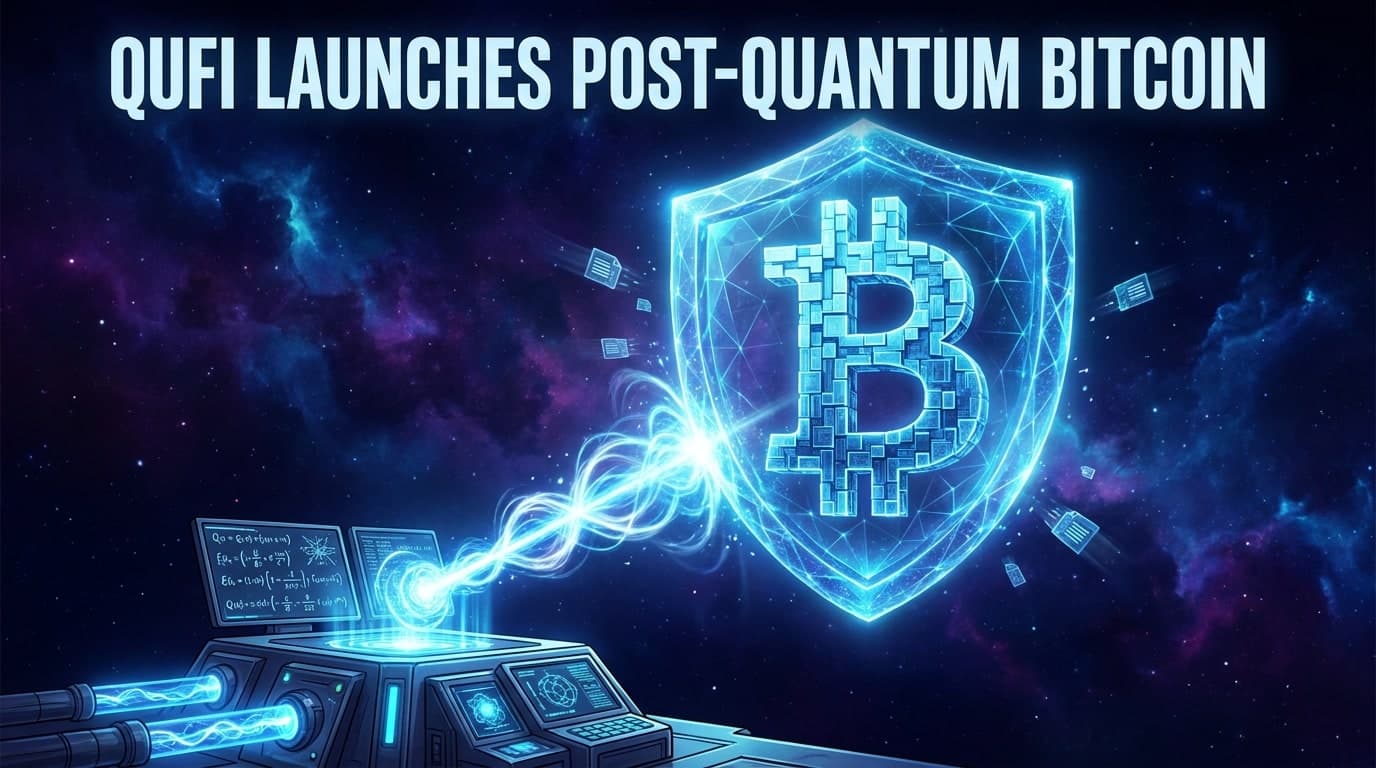
QuFi Network launched a post-quantum verification platform on 4 September 2026, testing Bitcoin security through a proof-of-concept called uBTC on Bitcoin Testnet4. Quantum computing could one day break Bitcoin's cryptographic signatures, so early testing like this shows how the network might defend itself before that threat arrives.
What actually happened
QuFi Network, a post-quantum infrastructure company, launched the platform on 4 September 2026, according to Cointelegraph. The system separates verification from settlement, using a decentralized network of nodes to validate transactions before they settle on existing blockchains. Its uBTC proof-of-concept verifies BTC collateral and generates cryptographic proofs for value moving between settlement environments, while redemptions still settle as standard Bitcoin transactions. The platform relies on three post-quantum standards, ML-DSA-65, SLH-DSA and ML-KEM-1024, for signatures and key exchange, avoiding the storage and bandwidth costs of adding larger signatures directly to a blockchain. Bitcoin's price showed no reaction to this infrastructure news. BTC traded at $79,626, down -1.59% over 24 hours, moving between $78,706 and $81,379, with 24-hour volume of $28.77 billion and a market capitalisation of $1.60 trillion.
How we got here
QuFi's launch follows a month of quantum-defense activity across crypto. In August 2026, StarkWare tested a quantum-resistant Bitcoin transaction on mainnet without a fork, though it took hours to compute and cost roughly $150 to $200. The same month, banks and regulators across Europe, the Middle East and Asia piloted post-quantum wallets using ML-DSA-65, one of QuFi's chosen standards. Blockstream researchers also published a Bitcoin Improvement Proposal called SHRINCS, an experimental post-quantum signature scheme still without a completed security proof. Bitcoin's protocol itself carries no quantum defenses yet, so each of these efforts tests a different route toward one.
Why this matters for you
For most Bitcoin holders, nothing changes today. QuFi's system runs on testnet, not mainnet, and does not touch how existing wallets or exchanges handle BTC. For builders, it offers a template: add post-quantum checks in a separate verification layer rather than rewriting Bitcoin's base protocol. For miners and node operators, any eventual quantum-defense standard, whether external like QuFi's or protocol-level like SHRINCS, will likely require coordinated upgrades. Holders should watch which approach gains developer consensus, since that will decide whether wallets, custodians or the protocol itself carry the burden of quantum resistance.
The bigger question
Should Bitcoin's quantum defense live inside the protocol itself, through proposals like SHRINCS, or in external verification layers like QuFi's, that sit on top of it? Protocol-level changes require consensus across miners, node operators and wallet developers, a slow and contentious process. External layers can move faster but add another system users must trust. Whichever path prevails will decide how much of Bitcoin's security depends on the base chain alone, and how much depends on separate infrastructure most holders never see.
What to watch
QuFi has not announced a mainnet timeline for uBTC beyond Bitcoin Testnet4. SHRINCS remains an early-stage proposal without a completed security proof, so further Bitcoin Improvement Proposal discussion is likely. On the regulatory side, the US Senate holds a procedural vote on the CLARITY Act on 15 September 2026, a separate but related marker for Bitcoin's institutional environment. Bonuz will track which quantum-defense approach gains traction as smart-glasses and Web3 hardware increasingly rely on the same cryptographic standards.
This article is information, not financial advice. Prices are a snapshot and change constantly. Nothing here is a recommendation to buy or sell any asset. Do your own research.