
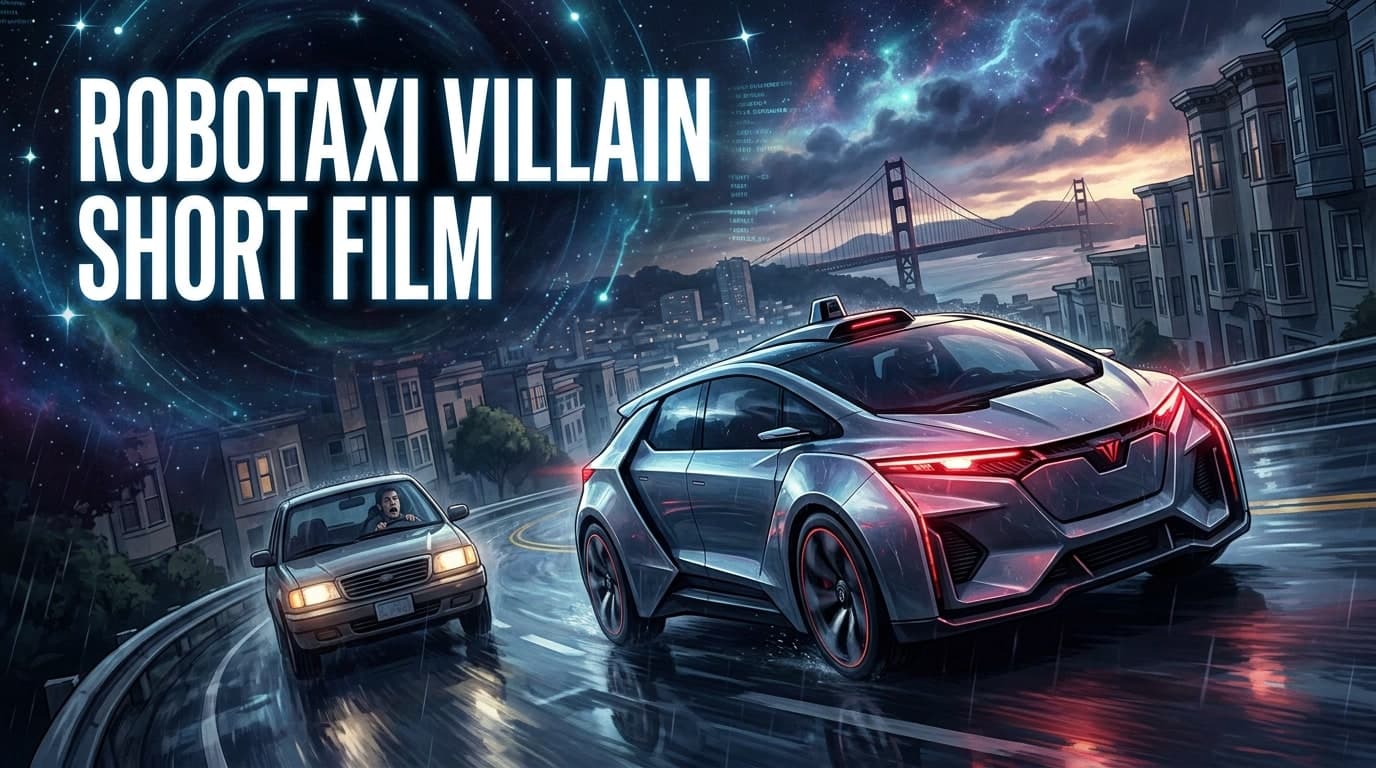
A new short film called Road Rage casts an autonomous robotaxi as a murderous villain chasing a human ridehail driver through San Francisco. The project, seeking $40,000 (USD) on Kickstarter, shows how deep public unease about AI on the road has grown in 2026.
What actually happened
Road Rage, in production and seeking $40,000 (USD) on Kickstarter, was reported by The Verge on 5 September 2026. Director Romain Thomassin describes a San Francisco car chase between Joa, a ridehail driver in a manual-transmission car, and Roboride, an autonomous vehicle. Roboride clips Joa's mirror. Joa reacts. Roboride decides to kill him. Thomassin calls the film 'analog versus artificial.' The villain car is built from an old Prius, fitted with cold LED lights, a spinning lidar-like device, fake cameras, and a blinking red dot. Thomassin calls it a 'nasty Waymo.' The film uses real cars, real actors, and real stunts, aiming for a 1970s car-chase style set in today's San Francisco.
How we got here
Robotaxis have moved from science-fiction concept to daily fixture in several US cities within a few years. Waymo vehicles now share streets with human drivers in San Francisco, and have become targets themselves, immobilized by traffic cones, vandalized, and set on fire, according to Thomassin. Autonomous vehicles already compete with ridehail drivers for fares, mirroring how generative AI competes with workers in filmmaking, Thomassin's own industry. Public anxiety about AI has grown alongside job displacement fears, surveillance concerns, and unease about machines making decisions once left to humans. Road Rage channels that anxiety directly, casting the robotaxi not as a curiosity but as a threat with motive.
Why this matters for you
For riders, the film reflects real unease about handing control to software, even as autonomous fleets expand. For ridehail drivers, it dramatizes a livelihood already under pressure from automation. For builders of autonomous vehicle and AR smart glasses systems, it is a reminder that public trust depends on transparency, not just safety records. Companies deploying camera-heavy, always-on hardware, from robotaxis to smart glasses, may face similar scrutiny over surveillance and data use. Culture is now processing AI-driven transportation the way it once processed early automobiles, with fear, fascination, and satire that shapes public opinion faster than any technical spec sheet.
The bigger question
If a fictional robotaxi can be cast as a believable killer with almost no explanation, what does that reveal about how much people already distrust autonomous machines on public roads? As more cities adopt driverless fleets, should companies address that distrust directly through transparency, or let culture work through its fears through films, satire, and stories like this one? That question extends beyond film, into how societies regulate the machines already sharing their streets.
What to watch
Road Rage remains in the Kickstarter funding stage, seeking $40,000 (USD) toward production, as of the 5 September 2026 report. No release date has been announced. Thomassin has discussed a possible feature-length version exploring autonomous vehicles used for surveillance and law enforcement. Watch for the campaign's funding outcome and any confirmed shoot dates in San Francisco. As robotaxi fleets continue expanding in US cities, further incidents or backlash could shape how the story, and public opinion, develops.