












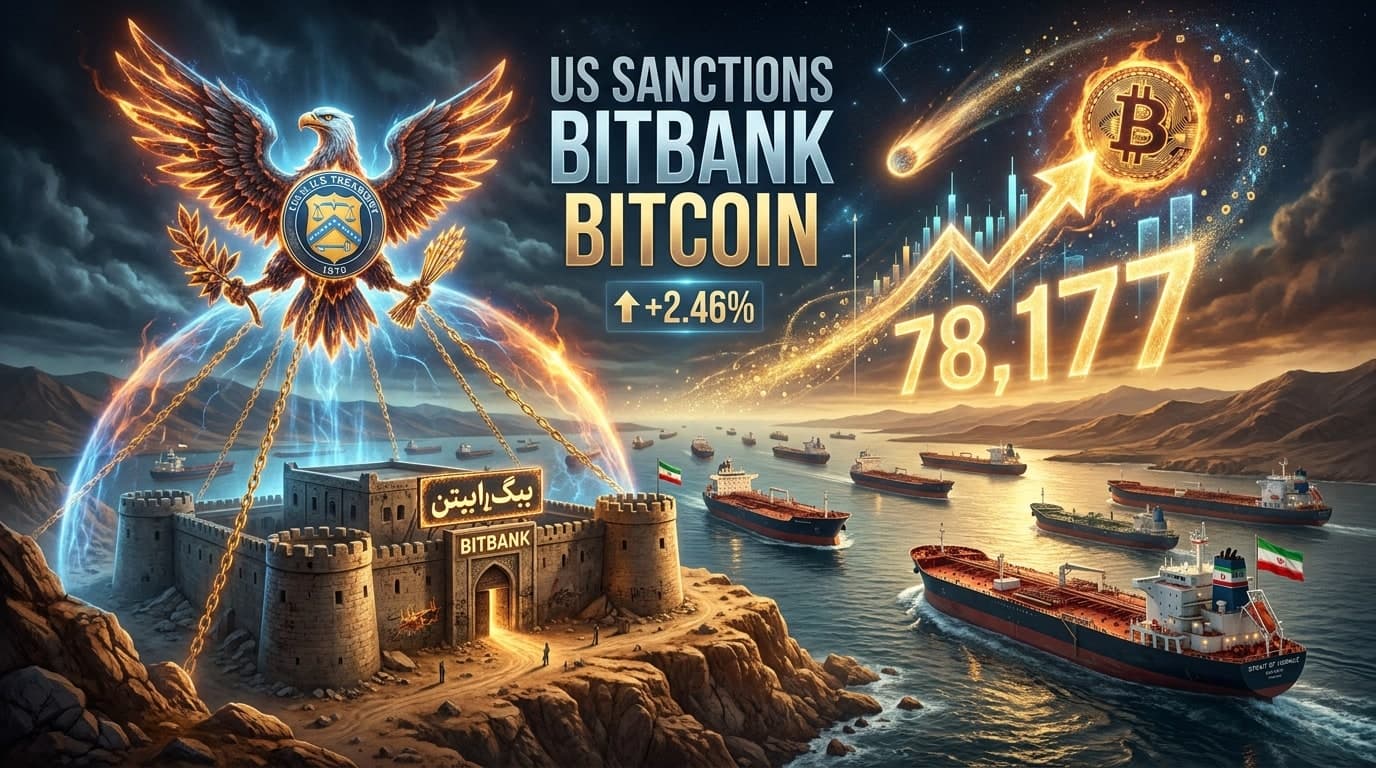
The U.S. Treasury sanctioned BitBank, a Tehran exchange accused of moving bitcoin to Iran's Revolutionary Guards through Strait of Hormuz toll payments. Bitcoin moved +2.46% to $78,177 in the same 24 hours, a reminder that sanctions on misuse do not automatically move the price of the asset itself.
What actually happened
The U.S. Treasury sanctioned BitBank, a Tehran-based exchange it says moved hundreds of millions of dollars in bitcoin to Iran's Revolutionary Guards. The exchange also processed payments that ships paid to cross the Strait of Hormuz, the world's most important oil chokepoint. Regulators said the previously sanctioned Hormuz Safe platform had routed those payments through BitBank since June.
Bitcoin traded at $78,177 as of this writing, a move of +2.46% over 24 hours. The 24-hour range ran from a low of $75,972 to a high of $78,372, on trading volume of $30.14 billion. Market capitalisation stood at $1.57 trillion. Separately, corporate treasuries bought just 5,900 bitcoin over three months, and ether and XRP exchange traded funds posted outflows even as bitcoin moved higher.
How we got here
CoinDesk reported bitcoin's climb from $75,972 marks a third straight day of gains, after weeks of choppy trading. The rally comes despite persistently soft demand data: corporate treasuries added only 5,900 bitcoin in three months, a fraction of the pace seen in prior quarters. Ether funds have now shed money for three straight sessions even as ether's own price rose, while zcash kept extending gains. Sanctions on Iran-linked exchanges are not new either; Hormuz Safe was already under U.S. restrictions before BitBank's designation this week.
Why this matters for you
For holders, the split between sanctions news and price action is the real signal today. Bitcoin's price moved on its own momentum, not on policy headlines, suggesting markets had already priced in enforcement risk around illicit use. For builders and exchanges, BitBank's designation is a warning: platforms handling sanctioned flows, even bitcoin flows tied to oil payments, face swift Treasury action. For anyone tracking demand, the 5,900 bitcoin corporate treasury figure and the ether and XRP outflows matter more than today's percentage gain. They suggest the rally is not yet backed by fresh institutional buying.
The bigger question
If bitcoin's price keeps rising while corporate and ETF demand stays weak, what is actually driving the buying, and can that source hold without institutional support? The answer matters beyond this week's numbers, because it tests whether bitcoin's price discovery still depends on the demand channels that built the last cycle, or whether something new has taken over.
What to watch
Watch for the next round of corporate treasury purchase data, due in coming quarterly filings, to see if the 5,900 bitcoin pace holds. Daily ETF flow reports will show whether ether and XRP outflows continue even as bitcoin gains. Further Treasury action tied to Hormuz Safe could also move sentiment around sanctioned crypto rails, though no specific date has been set.
This article is information, not financial advice. Prices are a snapshot and change constantly. Nothing here is a recommendation to buy or sell any asset. Do your own research.