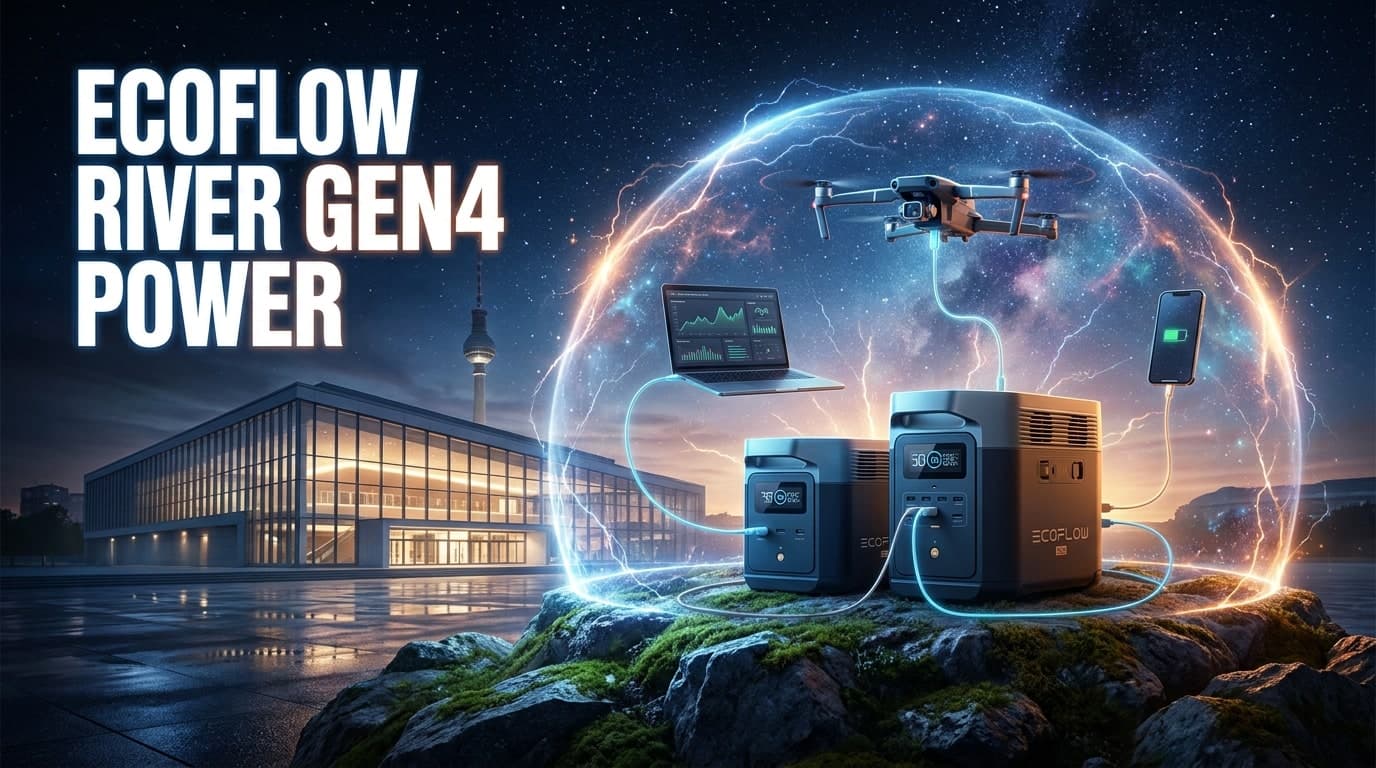
EcoFlow unveiled two new portable power stations, the River 260 Gen4 and River 520 Gen4, at IFA 2026 in Berlin. Both pack more energy into smaller, lighter bodies than earlier models. Anyone who charges a drone, phone, or laptop away from an outlet now has a denser, lighter backup option.
What actually happened
The River 260 Gen4 holds 256Wh in a 4.30 liter body weighing 3.0 kg (6.6 lbs), reaching 59.5 Wh/L energy density, according to The Verge. The River 520 Gen4 holds 512Wh in 5.63 liters at 4.6 kg (10.1 lbs), for 90.9 Wh/L, nearly double the density of EcoFlow's own River 2 Max. Both use LFP battery chemistry, described as longer-lasting and less volatile than older lithium-ion cells. The 260 Gen4 outputs 300W continuous through one AC jack; the 520 Gen4 offers two AC jacks totaling 500W. Each includes a 140W USB-C PD3.1 bidirectional port, letting the unit charge directly from a USB-C wall charger instead of a separate brick. Both switch to UPS backup in under 10 milliseconds, per EcoFlow.
How we got here
Portable power stations have grown popular for camping, blackouts, and remote work as EcoFlow, Anker, and Bluetti compete on capacity per liter. Earlier River 2 and River 2 Max models used denser but bulkier cells, trailing the Gen4 units by roughly 2.5 times in volumetric energy density, per EcoFlow's own comparison tables shared with The Verge. The announcement came at IFA 2026 in Berlin, the same show where rivals unveiled home robots, foldable phones, and drones, underscoring a broader push toward compact, multi-device power hardware for people who work and travel away from fixed outlets.
Why this matters for you
For campers, photographers, and remote workers, smaller and lighter units mean less weight in a bag without giving up runtime. A River 520 Gen4 can run a standard fridge for about four hours during a blackout, per EcoFlow. The bidirectional 140W USB-C port removes the need for a separate charging brick, a small but real convenience for anyone carrying multiple devices, including phones, drones, and eventually wearables like smart glasses. For builders and accessory makers, EcoFlow's shift toward USB-C PD3.1 charging signals where portable power hardware is heading: fewer proprietary cables, more shared standards across gadgets people carry every day.
The bigger question
Battery-dependent gadgets keep multiplying: phones, drones, fridges, and now emerging AR and smart glasses. Portable power stations are shrinking while holding more energy, but every device category still needs its own charge. Does the future belong to fewer, denser central power banks like these, or to gadgets that generate and store their own energy? EcoFlow's Gen4 series bets on the first path. Whether that holds as wearable hardware multiplies, and battery demands grow more personal and constant, remains an open question for the whole portable power industry.
What to watch
The River 260 Gen4 launches in Europe in Q4 2026. The River 520 Gen4 follows in Q1 2027. EcoFlow has not announced pricing for either model, saying details will come closer to each release date. As portable power and wearable hardware both compete for space in daily carry, bonuz will track how battery standards like USB-C PD3.1 shape future AR and smart glasses charging.