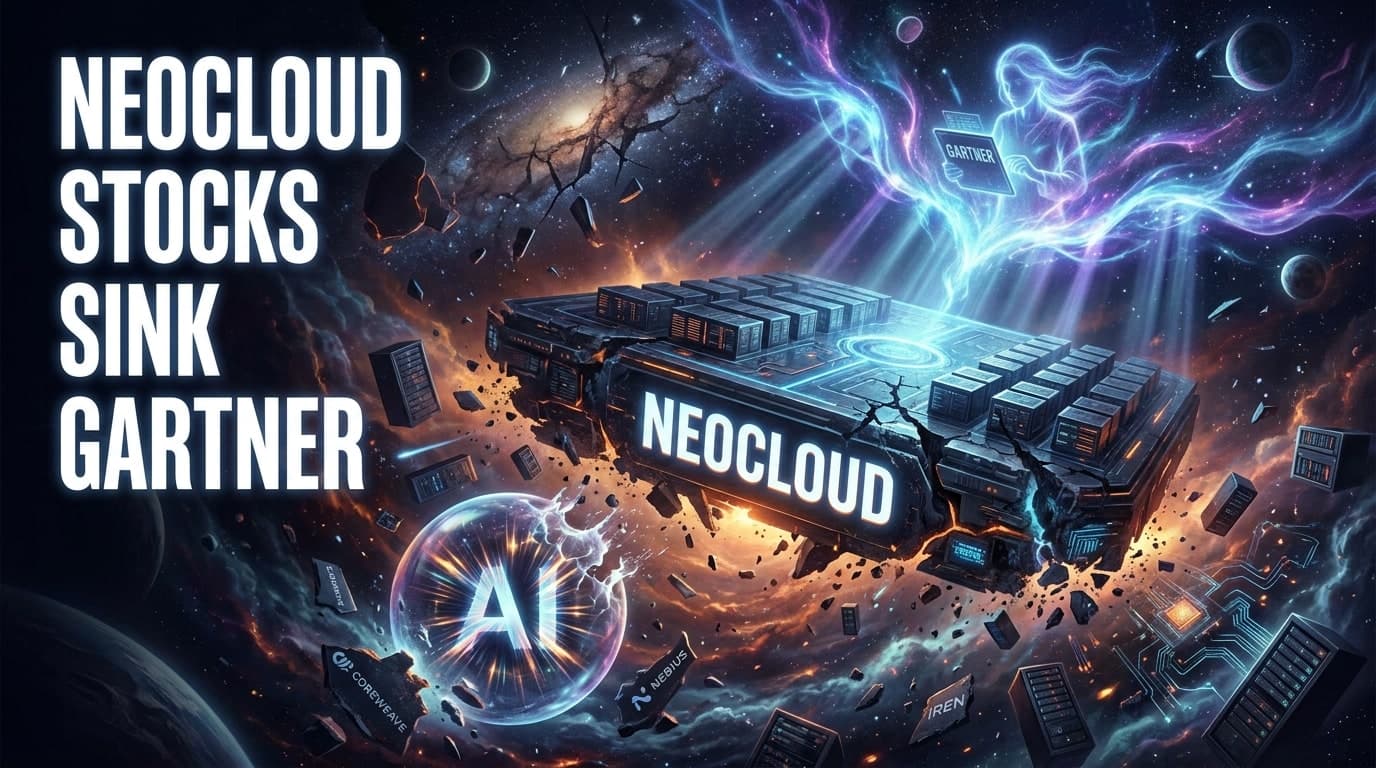
Neocloud stocks CoreWeave, Nebius and IREN fell sharply in October 2026 after Gartner predicted most GPU cloud providers will not survive as independent companies past 2030. Anyone holding AI infrastructure stocks, crypto miner shares, or compute tokens faces a direct read on how AI debt gets repaid.
What actually happened
On 14 October 2026, Gartner predicted that cost pressure and a lack of a differentiating business model will force more than 80% of neocloud providers to stop operating independently by 2030, according to Decrypt. Gartner also estimated more than $3.5 trillion (USD) in AI infrastructure spending could face impairment by the end of 2030. By 21 October 2026, CoreWeave's unsecured debt yielded about 15%, and the cost of insuring its bonds against default had risen 30% in a month. CoreWeave shares fell 29% in October, cutting its value to about $34 billion (USD), down from a 2025 peak near $90 billion (USD). Nebius dropped 27% over the same period despite lower net debt. IREN fell 32%. CoreWeave co-founder Brannin McBee said nearly all of the company's 2027 capacity is already sold, with contracts extending into 2028.
How we got here
Neoclouds emerged after the ChatGPT boom created a scramble for GPU capacity beyond what Amazon, Microsoft and Google could supply. CoreWeave started in 2017 as an Ethereum miner, then shifted its hardware to AI after Ethereum ended GPU mining in 2022, according to Decrypt. Bitcoin miners followed the same path, converting power sites into AI hosting campuses. In the two years to July 2026, miners contracted about 7 gigawatts of power capacity across 19 deals worth more than $135 billion (USD) with hyperscalers, neoclouds and chipmakers, Bernstein found. That is less than a quarter of the 30 gigawatts miners have planned.
Why this matters for you
For holders of CoreWeave, Nebius or IREN stock, the sell-off shows how debt-funded GPU buildouts can swing in value fast. Depreciation is heavy: CoreWeave reported nearly $1.4 billion (USD) in depreciation and amortization against $2.6 billion (USD) in revenue last quarter, per Decrypt's report. Bitcoin miner shareholders in TeraWulf, Cipher and Hut 8 now carry AI hosting exposure alongside mining, through multi-year leases with Google, Amazon and Anthropic. Builders watching DePIN tokens such as Render, Akash and io.net get a reminder that token-based compute networks target the same demand without the same balance-sheet risk. Users of AI tools may see service changes if smaller neoclouds get absorbed or shut down before 2030.
The bigger question
CoreWeave's co-founder says 2027 capacity is nearly sold out, with contracts running into 2028. Gartner says most providers will not survive as independent companies past 2030. Both can be true if the sector consolidates rather than shrinks. The open question is whether AI demand will stay high enough, for long enough, for neoclouds to earn back the debt they took on to build it, or whether today's GPU clusters become tomorrow's stranded assets.
What to watch
Watch CoreWeave, Nebius and IREN earnings reports for updated depreciation and debt figures. Gartner's 2030 deadline for neocloud consolidation is the benchmark against which the sector's 30-gigawatt Bitcoin-miner power pipeline will be tested. CoreWeave's booked contracts into 2028 offer a nearer-term signal. Bonuz will keep tracking how GPU infrastructure and crypto-miner hosting deals intersect with the compute needs behind AR and smart-glasses hardware.