










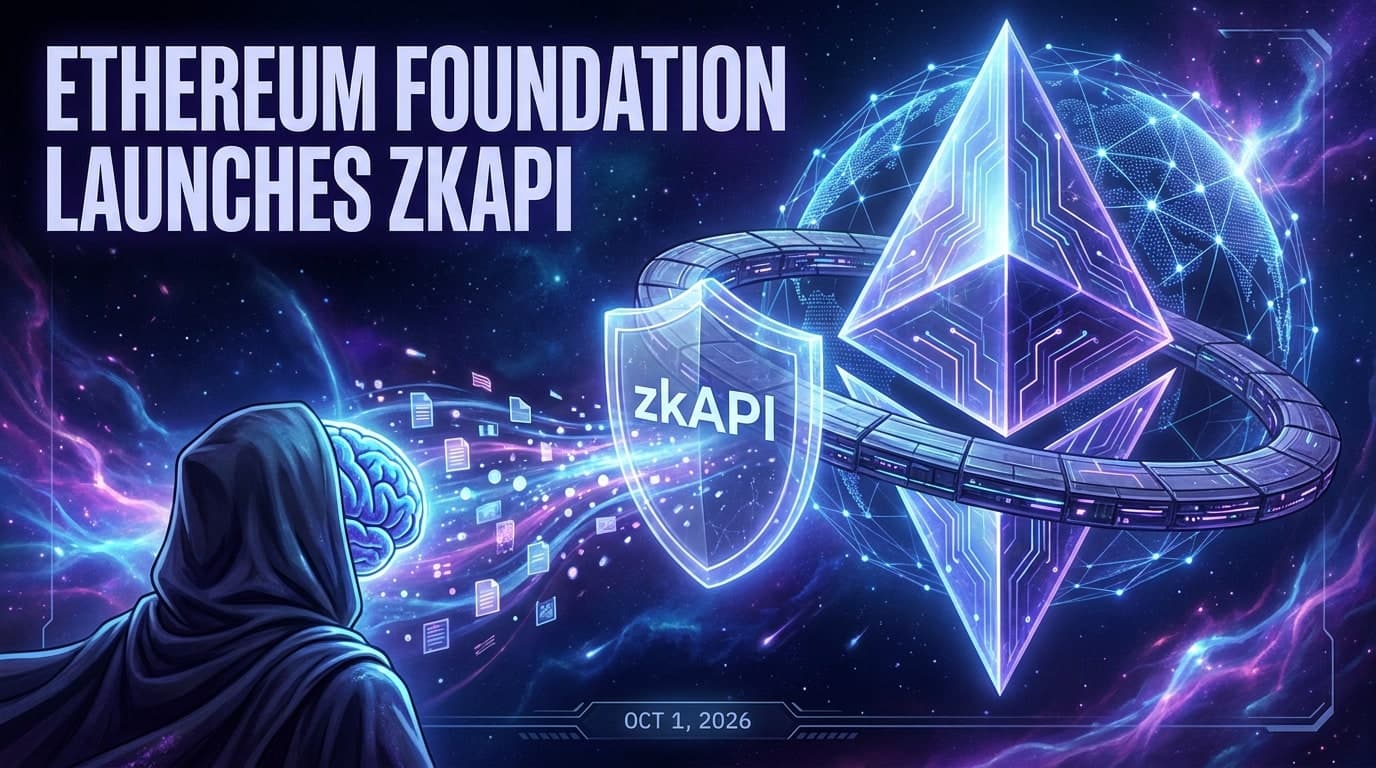
The Ethereum Foundation launched zkAPI on 1 October 2026, a system that lets users pay for AI models and other metered APIs without revealing who they are. It matters because it turns Ethereum into a privacy layer for the AI economy, not just a settlement rail for tokens.
What actually happened
The Foundation built zkAPI with the Open Anonymity Project and confirmed it is live on Ethereum mainnet, according to The Block. Users deposit ETH or USDC into a vault contract, which records their balance as a private note, then generate a zero-knowledge proof to authorize spending without revealing which deposit it draws from. Ken Liu of the Open Anonymity Project called it "a generalization of OA unlinkable inference that also abstracts payments away" in an X post. Separately, co-author Jerome de Tychey confirmed EIP-8363, a proposal to burn part of staking rewards, was pulled from the Hegota upgrade after contributors argued a scoping process was the wrong venue for an issuance change. Layer 2 network Blast also announced a shutdown citing unsustainable costs, with $63.5 million still in its canonical bridge. ETH traded at $2,696, up +0.78% over 24 hours, with a 24-hour high of $2,768 and low of $2,677. Trading volume reached $17.83 billion and market capitalisation stood at $329.29 billion.
How we got here
zkAPI implements a design Vitalik Buterin and Ethereum Foundation dAI lead Davide Crapis published on the Ethereum Research forum on 11 February 2026. The Foundation formed its dAI team in September 2025 to build Ethereum's role as a settlement layer for AI agents, and shipped ERC-8004, an agent identity standard, in January 2026. Buterin has since described Ethereum's path toward a "cryptographic world computer," per Wu Blockchain, with the planned Hegota upgrade possibly the last one that developers from 2015 would still recognize. The EIP-8363 withdrawal shows issuance changes still need broader consensus than a scoping process alone provides.
Why this matters for you
For builders, zkAPI offers a working template for metered, privacy-preserving payments beyond AI chat, including RPC queries, image generation and machine-to-machine payments between agents. For users, AI usage no longer has to build a profile tied to a wallet or API key, though the system does not hide network-level metadata and its GitHub repository still labels it experimental. For ETH holders, the Hegota decision confirms that issuance and monetary policy changes face a higher bar than ordinary scoping discussions. For anyone tracking Layer 2s, Blast's shutdown and its bridge deadline are a reminder that execution environments can disappear even after attracting real usage.
The bigger question
zkAPI proves identity-free payment for metered digital services is technically workable on Ethereum today. If AI providers adopt this pattern at scale, usage data tied to individual accounts could become far scarcer. That raises a genuinely open question: can an AI industry built on tracking usage and refining models from that data keep improving once large parts of its payment layer go anonymous by default?
What to watch
Blast users have until 26 October 2026 to withdraw through the normal bridge interface, after which only contract-based withdrawals continue. The Hegota upgrade is expected next year and may mark Ethereum's last upgrade recognizable to 2015-era developers, per Buterin. zkAPI remains labeled experimental, so expect audits and new use cases, such as agent-to-agent payments, before wider adoption.
This article is information, not financial advice. Prices are a snapshot and change constantly. Nothing here is a recommendation to buy or sell any asset. Do your own research.