
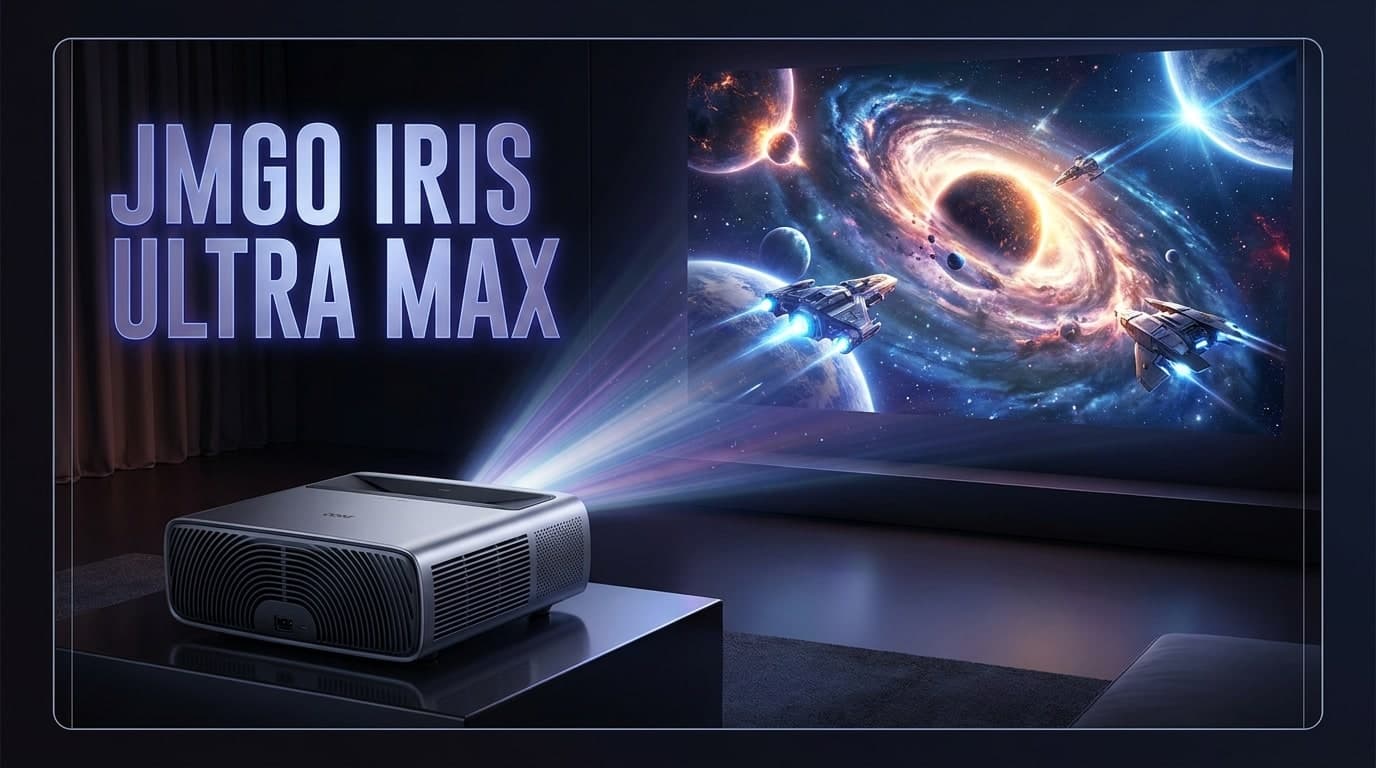
JMGO's Iris Ultra Max, a 4K 120Hz gaming projector, is now available for preorder outside China. It matters because it pushes home projector brightness and gaming features, like VRR and ALLM, into territory once reserved for premium TVs, at a lower price point.
What actually happened
The Iris Ultra Max runs Google TV and outputs 4K resolution at 120Hz, according to The Verge. JMGO says its new dual-iris system, two physical apertures placed at different points along the optical path, delivers a native contrast ratio of 10,000:1. A triple-laser light engine produces 6,500 ISO lumens of brightness. The projector supports Variable Refresh Rate (VRR) and Auto Low Latency Mode (ALLM), plus Dolby Vision HDR at 4K 120Hz. It sits on a motorized pan-and-tilt gimbal, with 0.88 to 1.7:1 optical zoom and lens shift up to plus or minus 130 percent vertically and 53 percent horizontally. JMGO lists the projector at $3,499 (USD), dropping to $2,999 (USD) for preorders starting 31 August 2026. Shipping begins 19 October 2026.
How we got here
Projector brightness has climbed fast at trade shows. At IFA 2025, an all-in-one projector reaching 6,000 lumens counted as a breakthrough, per The Verge. One year later, at IFA 2026, that figure looks like a baseline, with the Iris Ultra Max clearing it by 500 lumens. JMGO's previous flagship, the N3 Ultimate, used a single-iris design and struggled with color distortion at peak brightness, according to Verge reviewer Thomas Ricker. The Iris Ultra Max is JMGO's attempt to fix that weakness while also chasing gamers and sports viewers who need low latency and high refresh rates, features once limited to flat-panel TVs.
Why this matters for you
For buyers, the Iris Ultra Max offers TV-grade gaming features, VRR, ALLM, and 120Hz, in a projector for the first time at this brightness level. That could shift how people set up large-screen gaming and sports viewing at home, without needing a TV. For builders and rivals, JMGO's dual-iris approach sets a new bar for contrast control, pressuring competitors to match it. Buyers should still wait for independent reviews, since JMGO's own N3 Ultimate reportedly showed color distortion at peak brightness. Preorder pricing at $2,999 (USD) undercuts the eventual $3,499 (USD) list price, rewarding early buyers if the hardware performs as promised.
The bigger question
Projector brightness and gaming features are converging fast with flat-panel TVs. If projectors can match TVs on latency, contrast, and refresh rate, will more households choose a projector as their main gaming and sports screen instead of a television? Or will color accuracy and calibration challenges, like those seen on JMGO's earlier flagship, keep projectors as a secondary display for most buyers?
What to watch
Preorders for the Iris Ultra Max opened 31 August 2026, alongside other announcements at IFA 2026. Shipping is set for 19 October 2026, when independent reviews should confirm whether the dual-iris system solves the color distortion JMGO's earlier flagship faced. Bonuz will track how these display advances feed into the broader push toward brighter, faster screens for AR and smart glasses hardware.