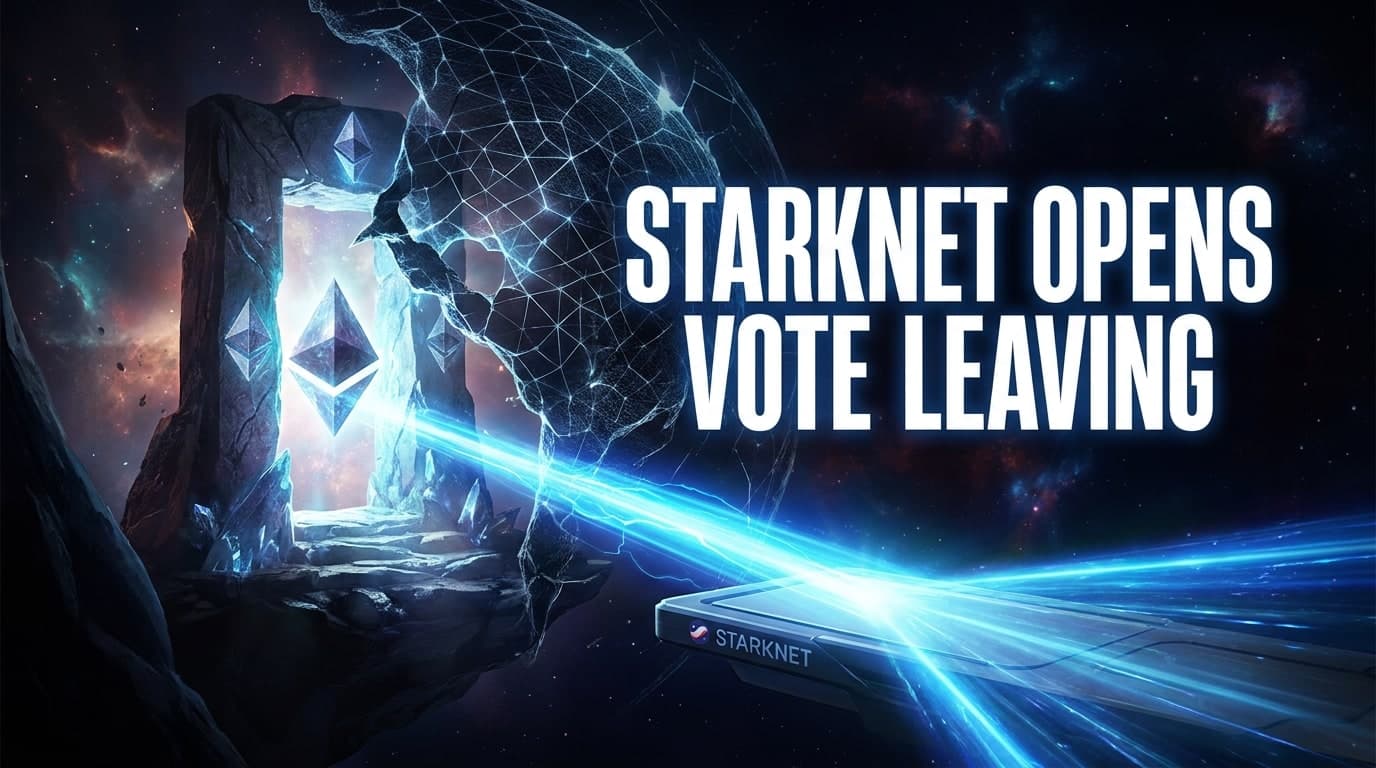
Starknet opened a seven-day vote on Thursday, asking STRK holders whether to research becoming an independent, post-quantum Layer 1. The vote tests how much Ethereum's scaling layers trust its own quantum-security roadmap, a question that affects anyone holding assets on an L2.
What actually happened
Starknet opened a seven-day poll on Thursday, asking STRK holders whether to research an independent, post-quantum Layer 1, according to The Block. The move would cut Starknet's reliance on Ethereum's own quantum-security upgrade timeline, Cointelegraph reported. Separately, Lido added direct ETH staking from four Layer 2 networks to its interface, according to The Defiant. Users receive wstETH from local liquidity pools while ETH bridges to Ethereum for staking, with pools replenished in the background. Nearly $1 billion (USD) in crypto positions were liquidated as bitcoin, ether and XRP slid, CoinDesk reported, with ether making up nearly 60% of the forced closures. ETH traded at $2,439, up +0.35% over 24 hours, between a high of $2,451 and a low of $2,325. 24-hour volume reached $20.14 billion, with a market capitalisation of $297.92 billion.
How we got here
Ethereum's roadmap treats quantum resistance as a long-term research item, not an immediate upgrade. Starknet's vote signals some Layer 2 teams want their own fallback plan instead of waiting on that timeline. The move lands amid a broader risk-off mood. Decrypt reported that Ethereum, XRP and Solana all saw 'outsized drawdowns' versus bitcoin this week, tied to a 3.7% consumer price index reading and rising odds of an October rate hike. Ethereum ETFs logged 11 straight days of net outflows totalling $782.8 million before a brief Tuesday inflow, followed by a further $129.5 million in outflows. ETH had outperformed bitcoin for three straight months, the first such run since March 2021.
Why this matters for you
For Starknet users, a successful vote would start a long research process, not an immediate exit. No tokens or bridges change today. For ETH stakers, Lido's four-network integration lowers friction: staking from an L2 no longer requires a manual bridge to mainnet. For holders generally, this week's slide shows ether's sensitivity to macro shifts. Ether accounted for nearly 60% of liquidations even though bitcoin fell less, a reminder that ETH often moves with more leverage attached. Builders watching Ethereum's security roadmap now have a public signal that some teams want contingency plans, not just patience.
The bigger question
Starknet's vote does not commit it to leaving Ethereum, only to studying the option. That alone raises a bigger question for the ecosystem. If a major Layer 2 can seriously consider voting itself off Ethereum's security roadmap, how much independence can any rollup actually claim, and would more L2s following that path make Ethereum's ecosystem stronger or simply more fragmented?
What to watch
The Starknet vote runs for seven days from 15 October 2026, with results due around 22 October 2026. Watch Ethereum ETF flow data for signs the outflow streak is ending. The Federal Reserve's October rate decision will shape near-term risk appetite across crypto, including ETH. Bonuz will track how Starknet's community votes and what it means for Layer 2 security design.
This article is information, not financial advice. Prices are a snapshot and change constantly. Nothing here is a recommendation to buy or sell any asset. Do your own research.