
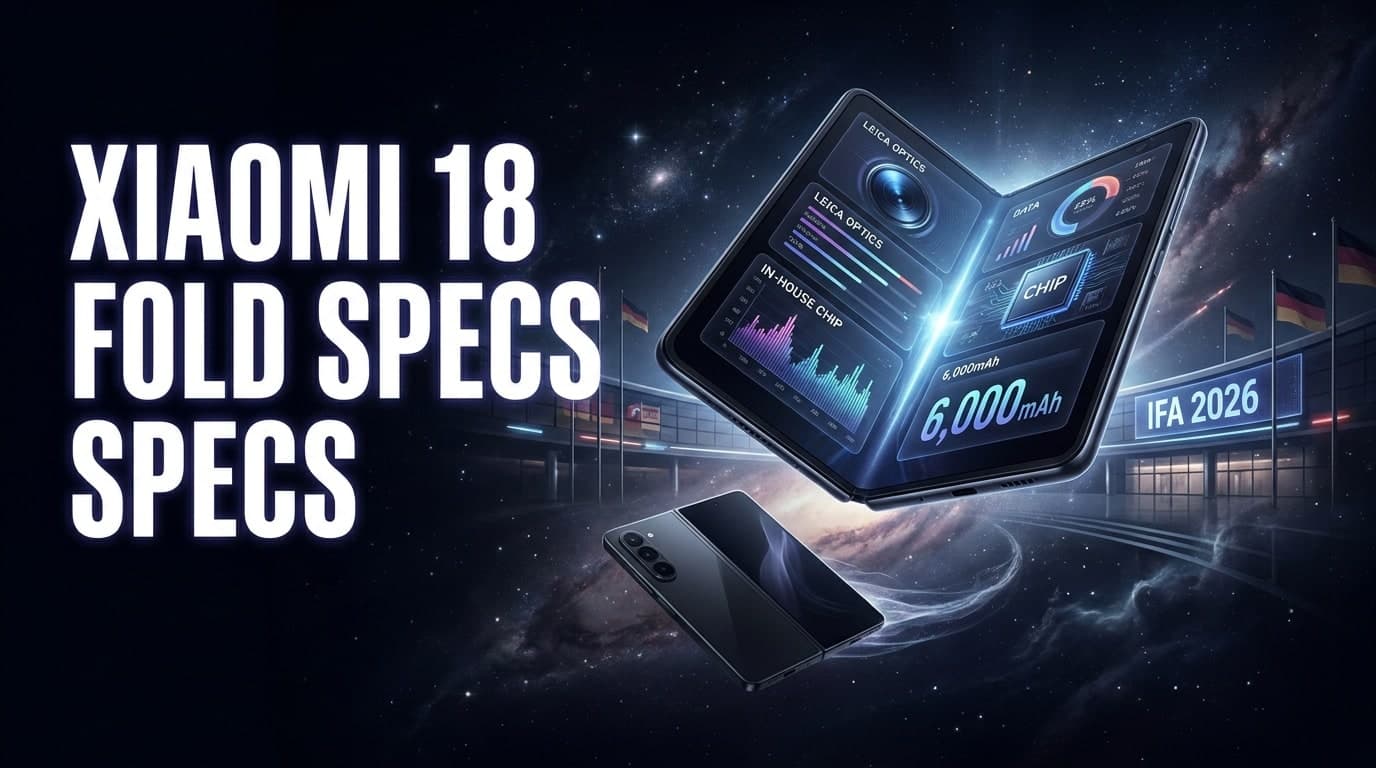
Xiaomi unveiled its 18 Fold foldable phone at IFA 2026, pairing a triple Leica camera with a new in-house chipset and a 6,000mAh battery. The device outguns Samsung's Galaxy Z Fold 8 on paper, raising the bar for foldable hardware just as Apple prepares its own foldable iPhone.
What actually happened
Xiaomi showed the 18 Fold at IFA 2026, a book-style foldable with a 7.58-inch inner screen and 5.38-inch outer screen, both near a 1.4:1 aspect ratio. The phone runs on Xiaomi's own Xring O3 chipset, its first, paired with Arm's new Mali G2-Ultra NX GPU for DLSS-style graphics acceleration on Android. A 6,000mAh silicon-carbon battery beats the Galaxy Z Fold 8's 4,800mAh cell, with 67W wired and 50W wireless charging. Both OLED panels hit 4,000 nits peak brightness. The triple rear camera, built with Leica, pairs a 200-megapixel main sensor with a 50-megapixel 3.5x periscope telephoto and a 50-megapixel ultrawide. The Verge reports the 18 Fold is available to preorder in China from ¥10,999, about $1,600 (USD), with sales starting 10 September 2026. The phone comes in black, white, red, and a 1,500-unit pink ceramic special edition. Reviewer Dominic Preston called it 'the phone I wish Samsung had made.'
How we got here
Xiaomi's last book-style foldable was the Mix Fold 4 in 2024. Since then, Huawei and Samsung both shifted to shorter, wider foldables, and Xiaomi follows that shape with the 18 Fold, going even wider than Samsung's Galaxy Z Fold 8. Oppo's Find N6 remains the only foldable to nearly erase the crease at the fold, a problem still visible on Xiaomi's new phone. The launch also lands the same week Apple is expected to reveal its first foldable iPhone, a debut widely expected to reshape the foldable phone category entirely.
Why this matters for you
For users, Xiaomi's spec sheet suggests the wide-foldable format still trails larger phones in polish, since Xiaomi skipped an IP rating altogether. Buyers in China get a genuine flagship-camera option at a lower price than the Z Fold 8, though international availability remains unconfirmed. For builders and component watchers, the Xring O3 chipset and its new Arm Mali G2-Ultra NX GPU show custom silicon and on-device graphics acceleration moving fast, technology that also underpins future AR glasses and wearable displays. Battery density gains, from 4,800mAh to 6,000mAh in a similarly sized shell, matter for any compact hardware, including smart glasses, where every gram and milliamp-hour counts.
The bigger question
Foldable phones keep adding cameras, brighter screens, and bigger batteries inside barely thicker shells. At what point does a foldable phone's hardware simply become the blueprint for the next wearable device, rather than a category of its own? As chipmakers and display makers refine components small enough for a phone that folds in half, the same parts may end up doing similar work inside frames worn on a face instead of carried in a pocket.
What to watch
Xiaomi's 18 Fold goes on sale in China from 10 September 2026, with preorders already open. Apple is expected to unveil its own foldable iPhone on 9 September 2026, a launch likely to reshape the whole category within weeks. Xiaomi has not said whether the 18 Fold will launch outside China. Bonuz will track how these foldable-phone components, chips, batteries, and cameras, filter into future AR and smart glasses hardware.