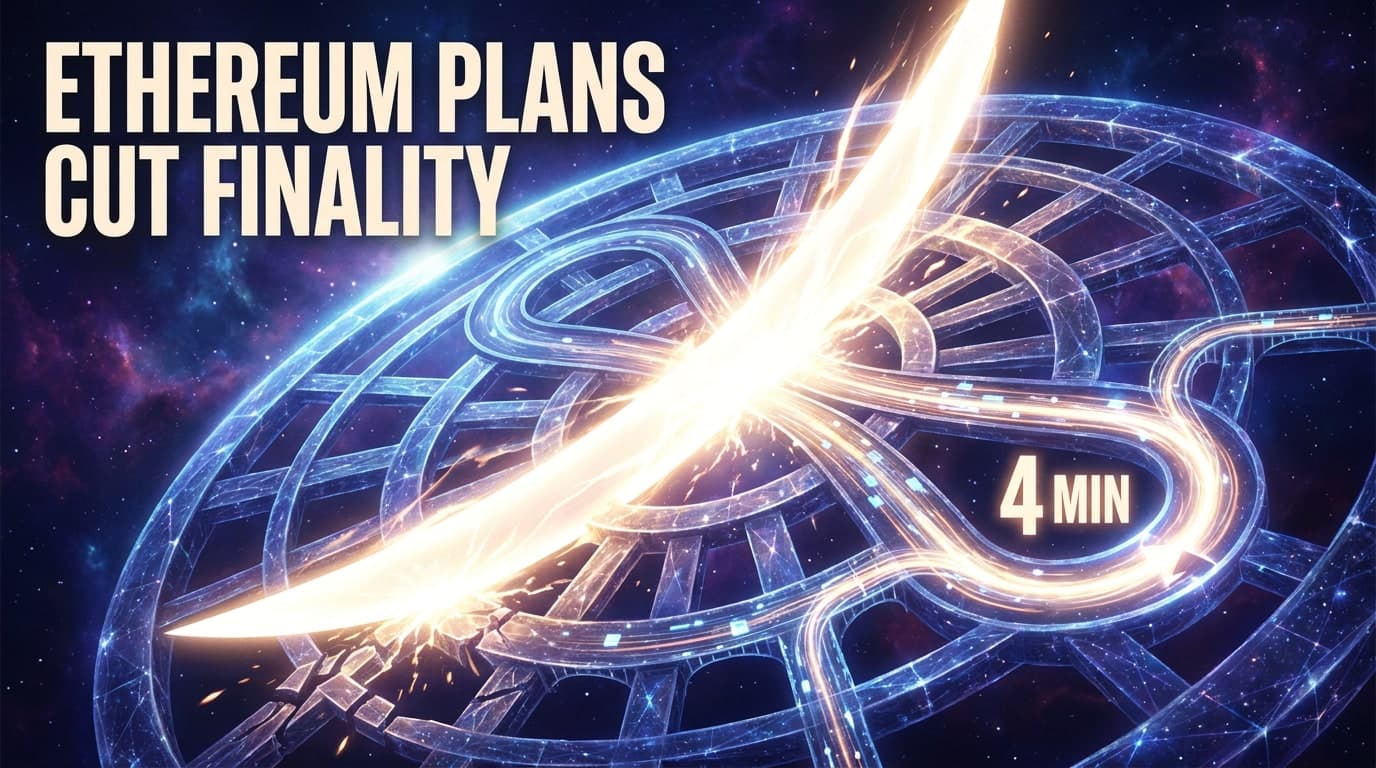
Ethereum researchers published a draft on Wednesday to cut transaction finality from about 16 minutes to roughly 4 minutes. Faster finality could lower costs for every service that moves money across blockchains, including stablecoin issuers and bridges.
What actually happened
Ethereum Foundation researcher Ben Edgington filed the draft on Wednesday with Francesco D'Amato, Roberto Saltini, Yann Vonlanthen and Mikhail Kalinin, according to CoinDesk. The plan targets a four-fold cut in finality, from about 16 minutes to roughly 4 minutes, though the design is unfinished with no activation date. Edgington wrote that 'many aspects remain TBD.' A service fronting $1 million an hour would tie up about $267,000 awaiting settlement at 16 minutes, versus roughly $67,000 at four minutes. Separately, Uniswap Labs launched aggregator hooks letting Uniswap v4 route trades through external liquidity on Ethereum, Base and Robinhood Chain, per The Block. ETH traded at $2,395, down -4.55% over 24 hours, after a 24-hour high of $2,519, on $12.07 billion in volume and a $292.50 billion market capitalization.
How we got here
Ethereum's 16-minute finality comes from validators casting one vote that both picks the next block and locks in older ones, with finality arriving only after two full voting rounds. The new proposal splits that single vote in two, letting the locking-in run on its own, faster clock. The timing is notable: Solana switched on its Alpenglow upgrade this week, targeting finality in about 150 milliseconds. Starknet's community also voted this week to research becoming an independent, post-quantum layer-1, with a draft whitepaper due in November, a sign that scaling and quantum-readiness are moving up roadmaps across Ethereum's ecosystem at once.
Why this matters for you
For holders, faster finality does not change ETH supply or issuance, but it could cut the implicit cost stablecoin issuers and bridges pass to users, since fast-transfer fees are tied to finality risk. For builders, a split-vote design opens room to tighten speeds further later without a full consensus rewrite, and it sets up an easier path to quantum-resistant signatures. For anyone moving funds off Ethereum, less capital sits idle in transit, which could mean lower transfer fees over time. None of this has an activation date yet, so near-term effects stay limited to research and discussion.
The bigger question
If Ethereum can safely cut transaction finality four-fold without weakening its security guarantees, what stops researchers from proposing a further cut once this one ships? Solana now settles in about 150 milliseconds, a fraction of Ethereum's proposed four minutes. Does that gap change what users and institutions consider 'final enough' across every chain, including Ethereum itself?
What to watch
Watch for Ethereum's draft to receive a formal proposal number, the next step that moves it into the upgrade pipeline. Starknet's community-backed whitepaper on an independent layer-1 is due in November 2026. Spot ether funds reportedly snapped a five-day outflow streak this week, a flow trend worth tracking alongside any finality timeline.
This article is information, not financial advice. Prices are a snapshot and change constantly. Nothing here is a recommendation to buy or sell any asset. Do your own research.