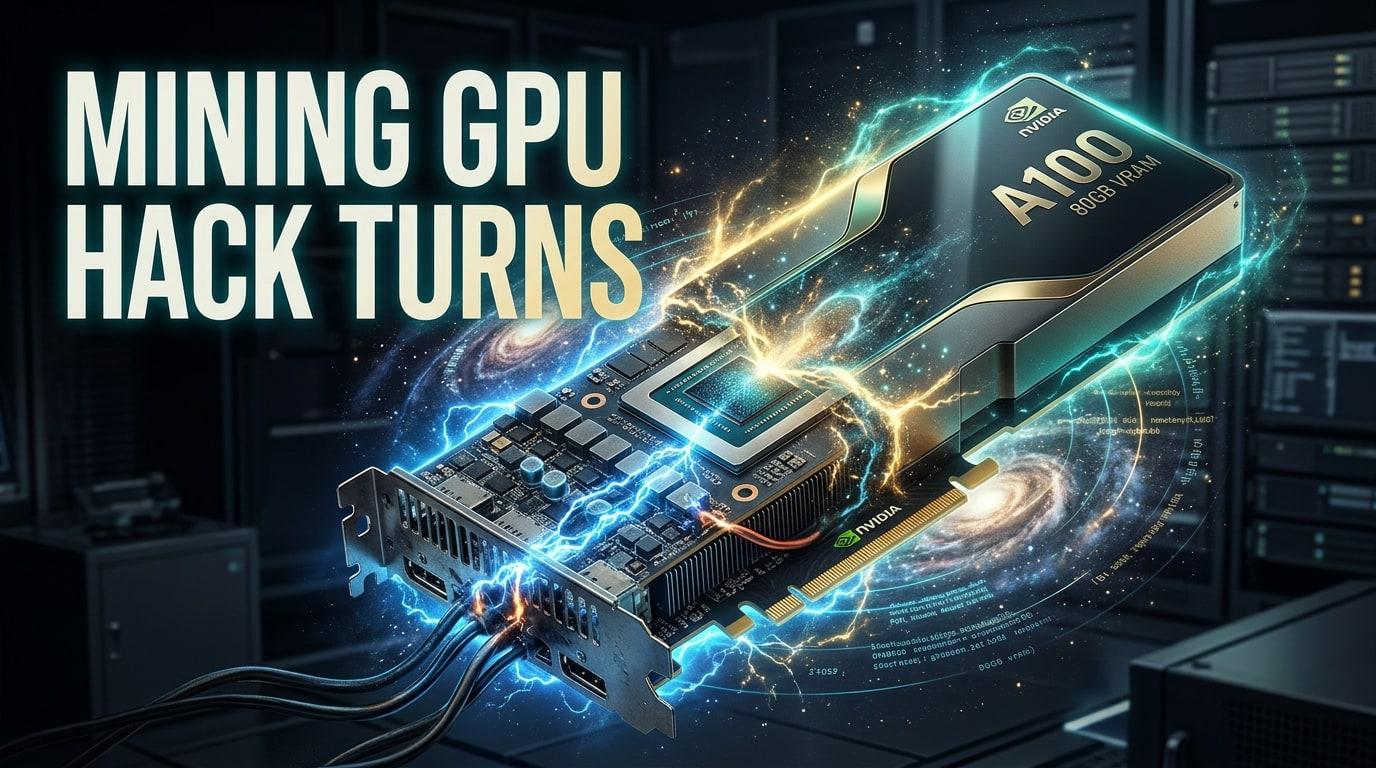
A hobbyist used voltage glitching to blow fuses on a $2,500 (USD) Nvidia CMP-170HX mining GPU, unlocking it into a $20,000 (USD) A100 class card with 80GB of VRAM. The trick matters because it exposes how thin the line is between cheap mining silicon and premium AI hardware.
What actually happened
According to Tom's Hardware, a technician converted an Nvidia CMP-170HX, a mining only GPU with 8GB of usable VRAM, into a card matching the specs of Nvidia's A100 80GB data center GPU. The CMP-170HX normally sells for about $2,500 (USD). A genuine A100 80GB sells for roughly $20,000 (USD) new. The modder used voltage glitching, a hardware attack that manipulates power delivery to force a chip into an unintended state, to carefully blow onboard fuses. Those fuses are what Nvidia uses to permanently disable extra VRAM and shader modules on mining cards before they leave the factory. Once reversed, the card reported its full 80GB of VRAM with all shader modules active.
How we got here
Nvidia launched the CMP, Cryptocurrency Mining Processor, line in 2021 during a GPU shortage driven by crypto mining demand. The goal was to pull miners away from gaming GPUs by offering stripped down cards with no display outputs and reduced capabilities. The CMP-170HX shares its underlying GA100 Ampere silicon with Nvidia's A100, the chip that powers much of today's AI data center infrastructure. Nvidia locks extra VRAM and compute modules on CMP cards using physical fuses, a method chipmakers use across product lines to split one piece of silicon into cheaper and premium versions. This case shows those fuses can be bypassed outside the factory.
Why this matters for you
For miners and hardware collectors, this suggests older CMP cards sitting unused since the 2021 mining crash could regain value as cheap AI compute. For Nvidia and other chipmakers, it raises questions about relying on fuses alone to separate product tiers and protect premium pricing. For AI builders hunting cheap VRAM, the appeal is obvious, but voltage glitching is destructive and unreliable. A failed attempt can permanently brick the card. There is no guarantee a glitched card performs or lasts like a genuine A100, and Nvidia offers no support for modified silicon.
The bigger question
If a $2,500 (USD) mining card can be physically converted into a $20,000 (USD) data center GPU, how secure is hardware based product segmentation across the chip industry? Chipmakers rely on fuses, not just software, to separate budget and premium versions of the same silicon. This case asks whether that holds up against low cost, physical attacks.
What to watch
Tom's Hardware has not published a date for when this modification was performed or verified. Watch for independent testing of whether a glitched CMP-170HX matches real A100 benchmarks under sustained load, and whether Nvidia responds with firmware checks on future cards. As cheap AI compute hunting continues, bonuz will track how hardware level workarounds reshape pricing for the GPUs underpinning AI and AR compute pipelines.