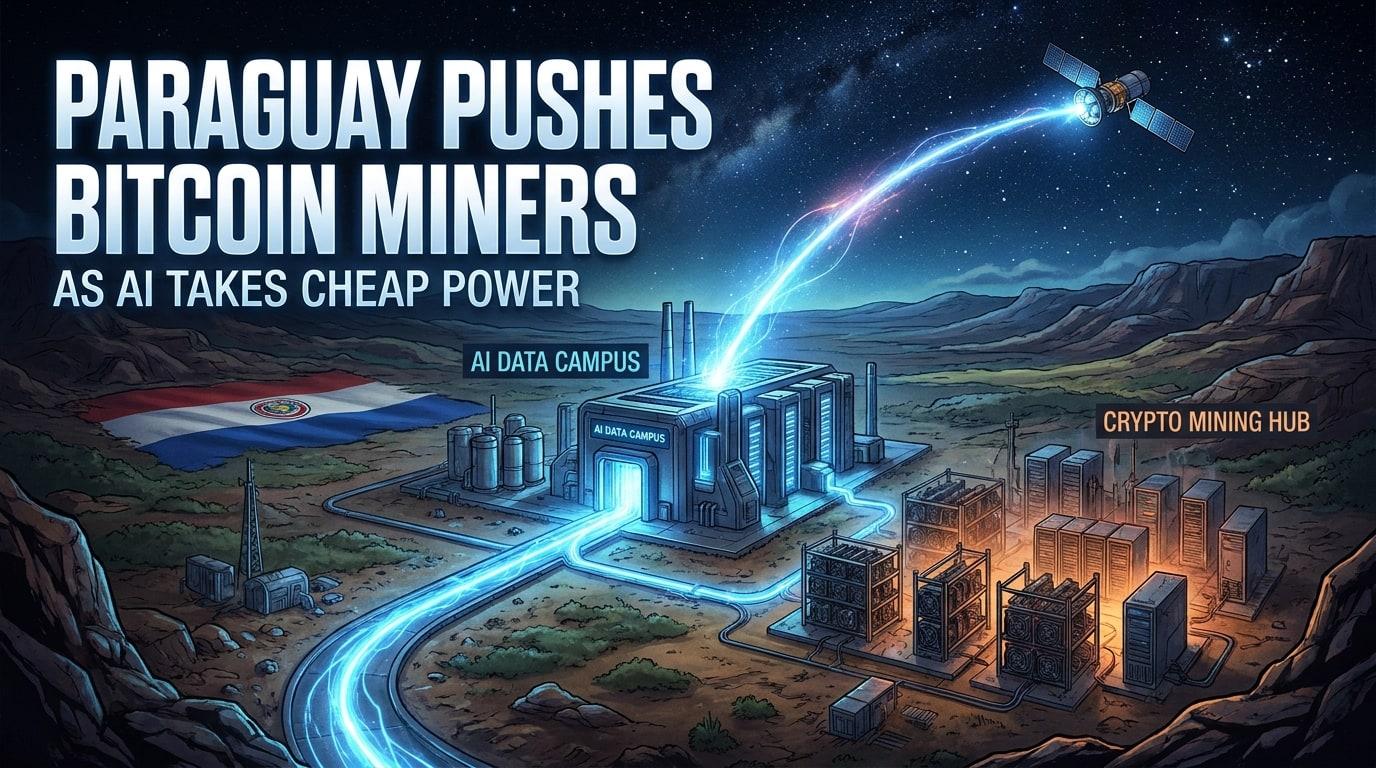
Paraguay's state utility will let bitcoin miners' cheap power contracts expire on 31 December 2027, favoring a new AI data campus instead. The shift shows cheap electricity, once a magnet for crypto mining, now flows toward AI infrastructure, a trend that could redraw the global map of bitcoin hash rate.
What actually happened
Paraguay's state power utility sells electricity to bitcoin miners covering 4% of global mining capacity, at $44 (USD) per megawatt-hour, according to CoinDesk. Miners pay the country $350 million (USD) a year under these contracts. The utility says the agreements expire on 31 December 2027 and calls that date final, meaning no renewal is expected. It has already signed a separate 15-year deal to supply power to an AI data campus backed by Founders Fund, a venture capital firm known for early bets on technology startups. The report does not name the utility, disclose the AI campus's location, or state its power capacity. No pricing terms for the AI deal were given either.
How we got here
Low-cost power contracts made Paraguay a global bitcoin mining destination, drawing miners who needed cheap electricity to run computing hardware profitably. That demand grew enough to account for 4% of the world's bitcoin mining capacity, according to CoinDesk. Globally, AI companies are now competing for the same kind of cheap, reliable power to run data centers and training clusters. Founders Fund's new campus deal fits that broader pattern, as AI infrastructure investment increasingly chases electricity contracts once reserved for crypto miners. Paraguay's utility choosing a 15-year AI commitment over renewing shorter mining deals reflects that shift in priorities.
Why this matters for you
For bitcoin miners, the deadline means relocating hash rate before 2028 or losing access to Paraguay's cheap power. Mining operations may shift to other low-cost power regions, potentially affecting the network's global hash rate distribution. For AI builders, the Founders Fund campus deal shows that long-term power contracts are becoming a competitive advantage in securing compute capacity. Energy-hungry AI infrastructure increasingly competes directly with crypto mining for the same limited supply of cheap electricity. For crypto holders, migrating hash rate could raise short-term mining costs and affect network security economics, though the report gives no estimate of affected hash rate volume or relocation plans.
The bigger question
Paraguay's state utility chose a 15-year AI power commitment over renewing bitcoin mining contracts worth $350 million a year. As AI data centers and crypto miners worldwide compete for the same cheap electricity, will other governments make the same choice, and what happens to bitcoin's global hash rate distribution if cheap power increasingly flows toward AI instead of mining?
What to watch
Watch 31 December 2027, when Paraguay's bitcoin mining power contracts officially expire. The 15-year AI campus deal with Founders Fund has no disclosed start date in the report. Further details on the utility's name, the AI campus's location, and capacity figures may emerge as the story develops. Bonuz will track how this power competition shapes AI infrastructure, a trend relevant to the hardware stack behind AI devices, including AR and smart glasses.