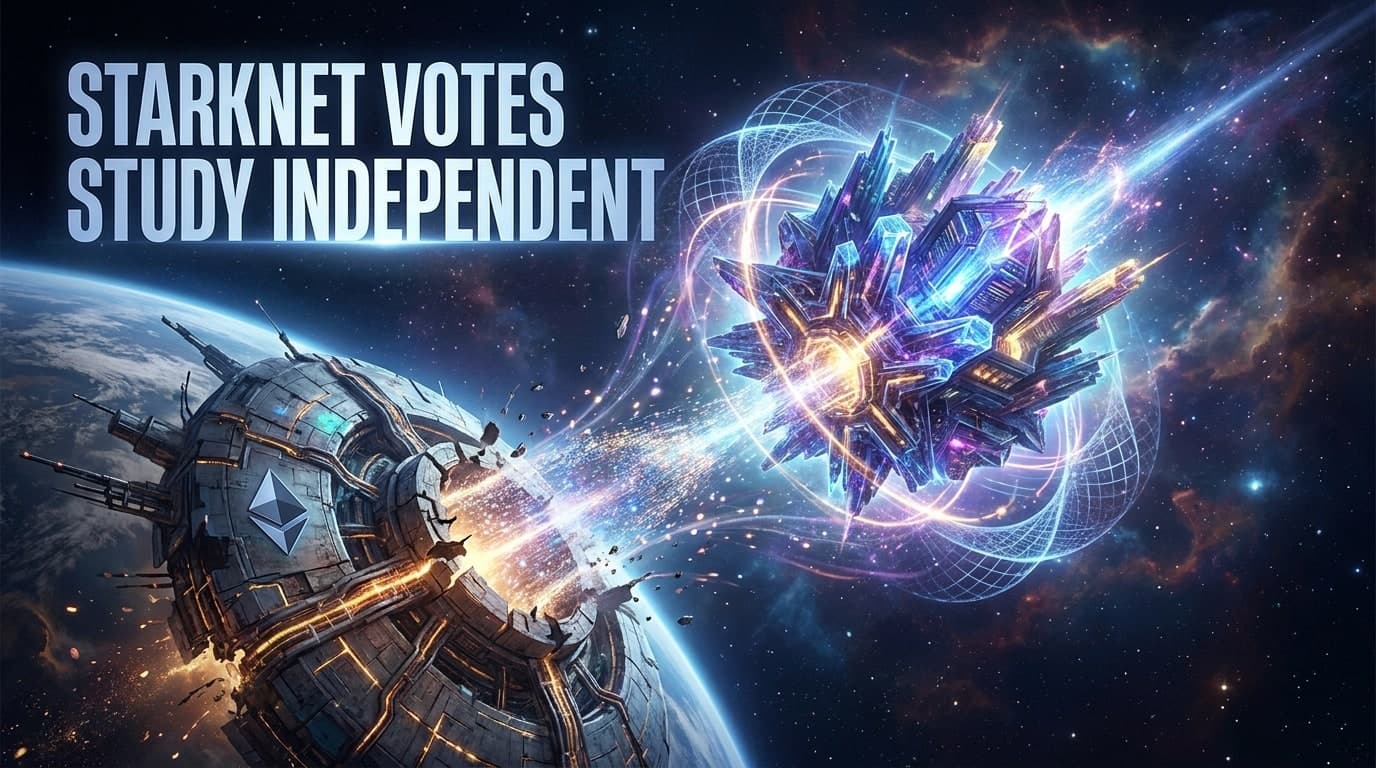
Starknet holders voted overwhelmingly to study leaving Ethereum as a Layer 2 and becoming an independent Layer 1 network built for post-quantum security. The move could reshape how one of Ethereum's largest scaling networks secures itself against future quantum computing risks.
What actually happened
Starknet STRK holders backed a research proposal with over 93.5% of voting power, according to Wu Blockchain. The vote explores migrating Starknet from an Ethereum Layer 2 to a standalone, post-quantum Layer 1 network. StarkWare, the company behind Starknet, plans to release a draft whitepaper covering the proposed transition in November 2026. The vote approves research only. It does not constitute formal approval of any migration plan. Further governance votes from STRK holders will be required before Starknet could actually leave Ethereum and operate as an independent chain. No technical details on the proposed post-quantum cryptography have been published yet. The timeline for a final decision has not been set.
How we got here
Starknet runs as a zero-knowledge rollup, settling transaction proofs on Ethereum for security and data availability. This structure ties its fees and performance partly to Ethereum's own network conditions. Concerns about quantum computing have grown across the crypto industry, since sufficiently advanced quantum computers could eventually break the cryptographic signatures used by most blockchains today. StarkWare has signaled interest in strengthening Starknet's long-term cryptographic resilience. The 93.5% result shows strong community support for studying alternatives, even though the vote commits Starknet to nothing beyond research, according to Wu Blockchain.
Why this matters for you
For STRK holders, the vote signals a possible long-term shift in how the network secures value and governs itself, separate from Ethereum. For developers building on Starknet, a future Layer 1 transition could change fee structures, settlement guarantees and existing tooling. For users, quantum-resistant security could offer stronger long-term protection, but any migration carries execution risk and years of engineering work. Nothing changes immediately. StarkWare's draft whitepaper, expected in November 2026, will be the first real signal of what a transition could actually look like.
The bigger question
If Starknet leaves Ethereum to become an independent Layer 1, does it still benefit from Ethereum's security and liquidity? Layer 2 networks exist to inherit a base chain's trust guarantees. Walking away from that model raises a bigger question for the entire rollup ecosystem: can quantum-resistant security be built without losing the shared security that made Layer 2 networks valuable in the first place?
What to watch
StarkWare plans to release a draft whitepaper on the proposed transition in November 2026. Any actual migration will require additional governance votes from STRK holders. Readers tracking Starknet, and the wider Layer 2 landscape, should watch for the whitepaper's technical details first. Bonuz will follow how this affects wallets and apps built on Starknet infrastructure.