












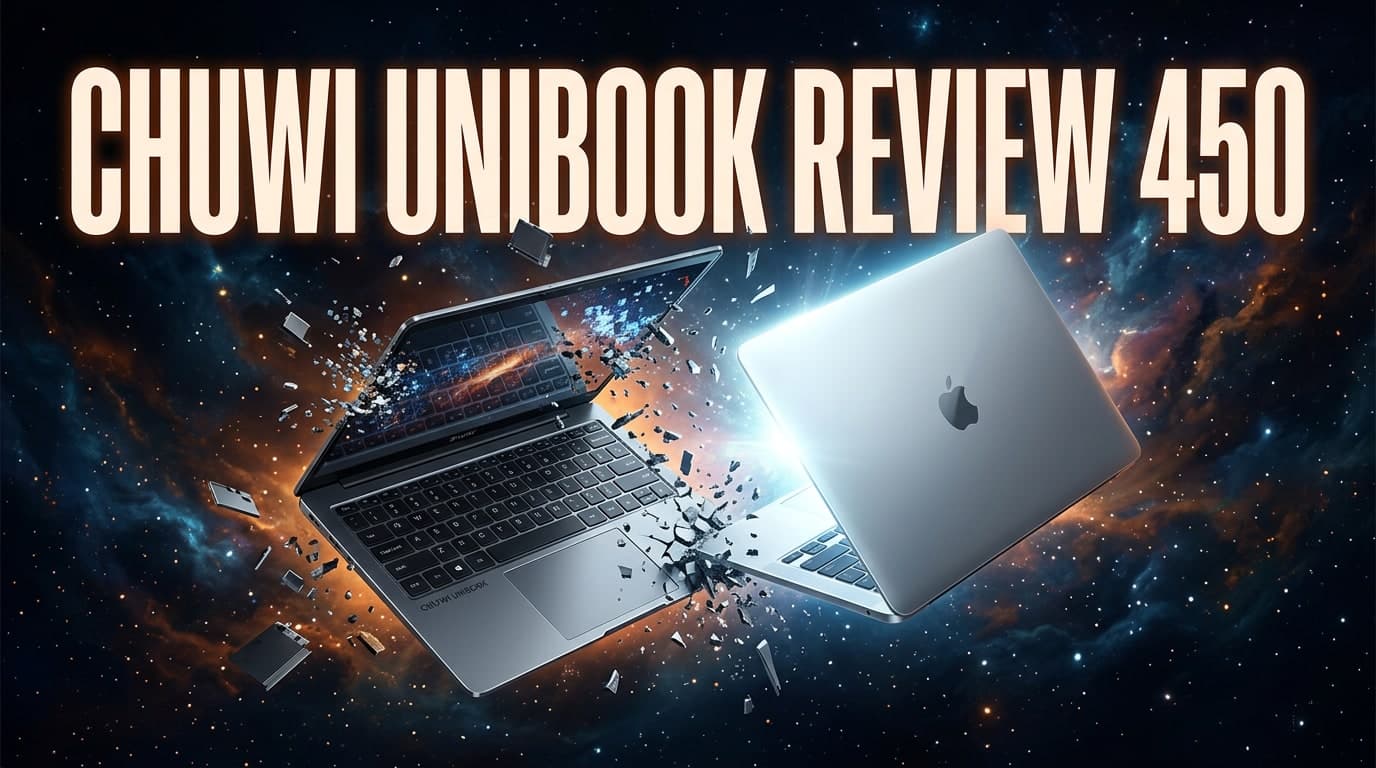
Chuwi launched a $450 aluminum Windows laptop called the UniBook, promising to undercut Apple's MacBook Neo. The Verge's review found it fails on nearly every component. This matters because it shows how far a cheap price tag can go before the compromises catch up with real use.
What actually happened
The Chuwi UniBook costs $450 (USD) and ships in one configuration: a 14-inch screen, an Intel Core 3 304 "Wildcat Lake" processor, 8GB of soldered RAM, and a swappable 256GB SSD, according to The Verge. The Verge tested it against Apple's MacBook Neo, which starts at $699 (USD) after a price rise from $599 (USD). In Geekbench 6, the UniBook scored 2385 on single-core CPU and 6187 on multi-core, versus 3402 and 8508 for the MacBook Neo. Its GPU score of 6019 trailed the Neo's 19798. A 4K video export in Adobe Premiere took 1 hour, 9 minutes, 29 seconds on the UniBook, compared with 8 minutes, 30 seconds on the MacBook Neo. The Verge gave the UniBook a Verge Score of 3 out of 10, citing a weak screen, poor trackpad, weak speakers, and a low-resolution webcam.
How we got here
Affordable laptops have long meant weak chips and cheap parts, a problem worsened by a recent memory price spike industry watchers call RAMageddon. Apple's MacBook Neo broke that pattern in 2026, launching at $599 (USD) with solid build quality, later rising to $699 (USD). Chuwi, a lesser-known Chinese hardware maker, aimed to beat that price with the Wildcat Lake chip, Intel's newest budget silicon. But Chuwi already faced scrutiny in early 2026, when it was found shipping laptops and mini PCs with older AMD chips disguised as newer ones, even at the BIOS level. The company blamed a "production error" and offered limited-time refunds, according to The Verge.
Why this matters for you
For budget buyers, the UniBook is a warning, not a bargain. A low price does not guarantee usable hardware, especially on the screen, trackpad, and speakers, which shape daily comfort more than benchmarks do. For builders and hardware makers, the review shows Wildcat Lake's lowest-tier chip struggles against Apple silicon and rival Windows machines like the HP OmniBook 3 or Acer Aspire 14 AI. Component choices like RAM and screen quality matter as much as the processor. For anyone tracking the broader budget laptop market, Chuwi's earlier chip mislabeling scandal adds a reputational risk on top of hardware shortcomings, raising real questions about long-term support and trust in newer brands.
The bigger question
Can lesser-known hardware makers ever compete on price without cutting corners that consumers feel every day? The UniBook's port selection and battery life show ambition, yet its screen, trackpad, and speakers reveal where budget hits its limit. As more brands chase cheap chips like Wildcat Lake, buyers face a harder question: is a low price worth accepting hardware that makes daily use unpleasant? The answer may shape which brands survive in a market Apple's MacBook Neo has already reset.
What to watch
The Chuwi UniBook launched at $450 (USD) and is available now, according to The Verge. More laptop makers are expected to release budget models using higher-end Wildcat Lake chips through 2026, which could test whether Intel's new low-cost silicon fares better outside Chuwi's configuration. Buyers considering sub-$500 laptops should watch how those higher-tier Wildcat Lake models perform before assuming the chip family itself is the problem.