












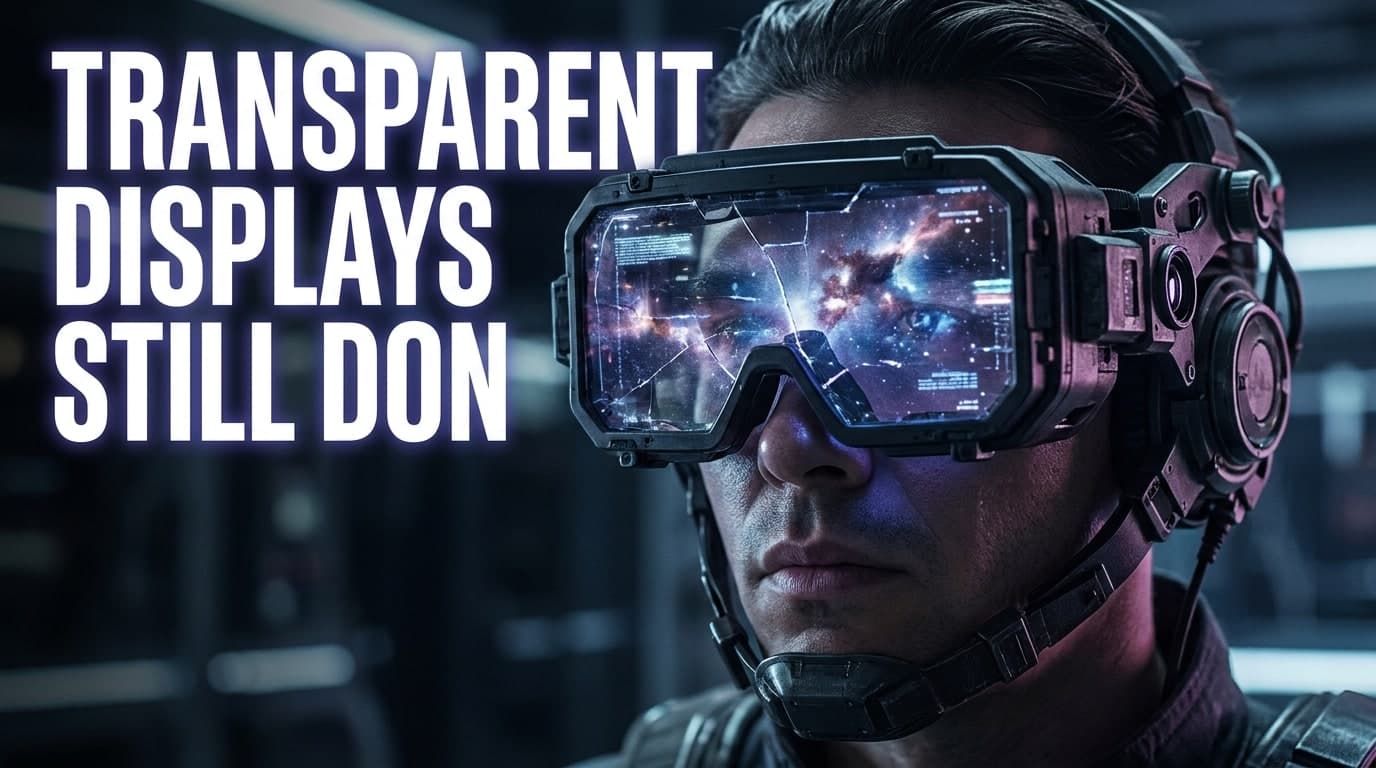
A leading AR display analyst says transparent OLED and MicroLED screens still cannot work as simple see-through displays for smart glasses. The finding matters because it explains why most AR headsets still rely on bulky waveguides instead of sleek transparent panels.
What actually happened
Karl Guttag of KGOnTech published the analysis on 10 August 2026, after Ron Mertens of OLED-Info asked why no simple transparent display sits directly in front of AR users' eyes, in a piece on KGOnTech. Guttag studied approaches from Fraunhofer, LusoVu, and Newsight Reality. Each company groups pixels into clusters of about 64 by 64 to 128 by 128 pixels, with optics placed over each cluster. These clustered optics measure 1 to 2 millimeters wide when placed close to the eye. Guttag wrote that the image only appears as one continuous picture when the eye sits in an exact 3D position, creating a very small eye box. LusoVu uses Holographic Optical Elements, while Fraunhofer and Newsight rely on conventional micro-lens optics.
How we got here
Optical see-through AR headsets have long promised a simple transparent display placed directly in front of the eye, similar to large transparent OLED panels used in retail settings. That approach works at a distance, because the ratio of pixel size to display size differs. Near-to-eye displays sit only about 2.5 centimeters from the eye, so optics are required between the pixels and the eye for the eye to focus at all. Guttag says shifting that focus distance to at least 25 centimeters, and preferably about 2 meters, creates darkening, distortion, and diffraction problems that large transparent displays never face.
Why this matters for you
For AR headset builders, the finding means waveguide and prism-based optics remain the practical path for now, since clustered transparent microdisplays add cost, thickness, and a shrunken eye box. For hardware investors and component suppliers, continued demand favors established display and optics makers over new transparent-panel startups. Companies pursuing fully invisible AR glasses will likely need alternative approaches, such as waveguides or reflective combiners, rather than transparent microdisplays. For everyday users, expect current smart glasses to keep visible optical modules rather than fully clear lenses, at least through the near term.
The bigger question
Guttag argues the fundamental focus problem facing transparent near-to-eye displays is unlikely to be solved soon. That raises a bigger question for the whole AR industry. Will any future advance in micro-optics, holographic elements, or new materials ever let a transparent microdisplay sit directly in front of the eye without darkening, distorting, or narrowing the real world view, or will optical AR always need indirect paths like waveguides instead?
What to watch
Guttag will present a Master Class on optical see-through AR hardware and optics at MicroLED and AR/VR Connect in Eindhoven, Netherlands, on 15 September 2026. The conference and exhibition run from 15 to 17 September 2026. A panel featuring Bernard Kress of Google, Berthold Hahn of Meta, and Barry Silverstein of the University of Rochester will follow, covering MicroLEDs, LCOS, lasers, and Micro-OLED light engines for AR.