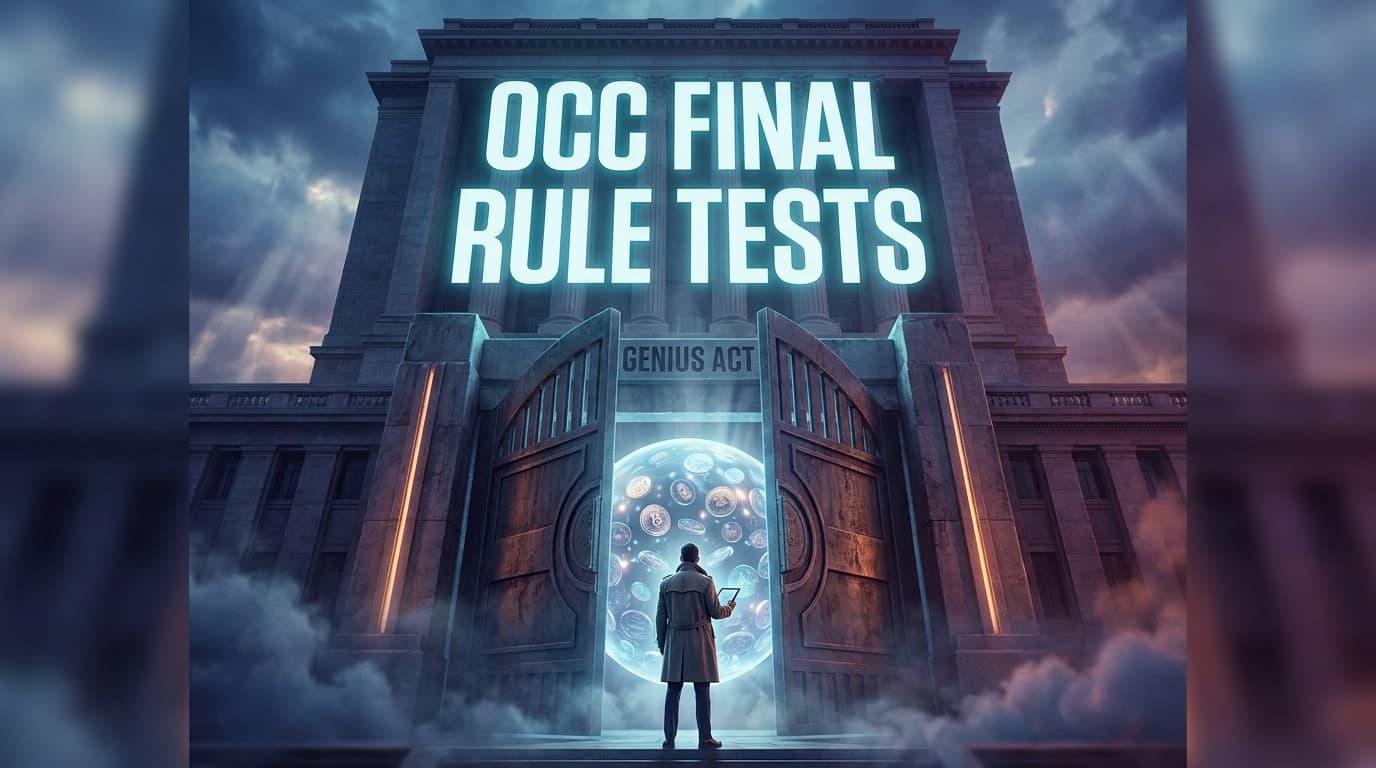
The U.S. Office of the Comptroller of the Currency issued the first final rule implementing the GENIUS Act on 21 October 2026, declining to grandfather existing stablecoin reward programs. That decision matters because it forces every crypto exchange offering stablecoin rewards to seek individual regulatory approval, setting the template other agencies will follow.
What actually happened
The OCC's final rule, issued Wednesday, implements the Guiding and Establishing National Innovation for U.S. Stablecoins Act, known as GENIUS. It takes effect 18 January 2026. The rule states that 'the OCC declines to presume that rewards programs that predated the GENIUS Act comply with the GENIUS Act,' according to CoinDesk. Treasury Secretary Scott Bessent called the rule 'a clear, practical foundation for private-sector innovation, competition, and American leadership in digital assets.' Current reward rates include PayPal's 4% return on PYUSD, Coinbase One's 3.75% on USDC, and Kraken+'s up to 4.5% on USDG. The OCC removed earlier 'rebuttable presumptions' that would have automatically flagged certain reward structures as violations, opting instead for case-by-case review.
How we got here
GENIUS passed to create a federal framework for dollar-pegged stablecoins, banning issuers from paying yield 'solely in connection with the holding, use, or retention' of tokens. Banks lobbied hard against stablecoin rewards, viewing them as a threat to deposits, and pushed for changes through the later Digital Asset Market Clarity Act. That bill failed to advance in a key Senate vote last month, leaving GENIUS's original yield ban intact. Exchanges like Coinbase had already built rewards programs resembling credit-card perks before the law existed. The OCC is the first of four agencies, alongside the FDIC, Treasury and Federal Reserve, to finish a GENIUS rulemaking.
Why this matters for you
For exchange users, reward rates on stablecoins are not guaranteed to survive this scrutiny. The OCC will judge each program by whether it serves a purpose beyond simply holding the token, a test with no fixed definition yet. For builders, designing a reward program now means proving it is not paid 'solely' for holding stablecoins, perhaps by tying it to trading activity or subscription tiers. For issuers like Tether and Circle, the ruling does not ban third-party exchange rewards outright, but it removes any presumption of safety. Holders should expect rates to shift as individual programs face review rather than blanket rules.
The bigger question
The GENIUS Act bans yield paid 'solely' for holding a stablecoin, but allows rewards tied to other reasons. Who decides where that line falls, and how much certainty can an industry have when the test depends on a single word applied case by case? Could this approach invite inconsistent rulings across similar reward programs, or will it force exchanges to redefine what counts as legitimate incentive design?
What to watch
The GENIUS Act's overall effective date arrives 18 January 2026, though other regulators may not finish in time. The FDIC, Treasury Department and Federal Reserve all have pending rulemakings covering state-chartered banks, foreign issuers and member-bank subsidiaries. Watch for how exchanges respond to the OCC's case-by-case approach in the coming months, and whether Congress revisits the Digital Asset Market Clarity Act after its stalled Senate vote.